Goddammit!
In all honesty, I thought I was done with Ms. Lena Dunham. I said everything I wanted to say about “her Movie,” and “her Show,” and her “success”; I analyzed the background, motivations, and the role of the hipster media; I expressed my opinions – negative and otherwise (HBO’s Girls Still Play with “Tiny Furniture”, 2013 Golden Globe Awards, and the breakthrough 8th episode of season 2). The topic was important to me as yet another evidence of social and intellectual degradation of the so-called “cultured” bi-coastal populace. But as far as I was concerned, I exhausted the subject – I threw it into my waste basket, all used-up and crumpled. I had no future expectations (I still don’t) and I simply stopped paying attention.
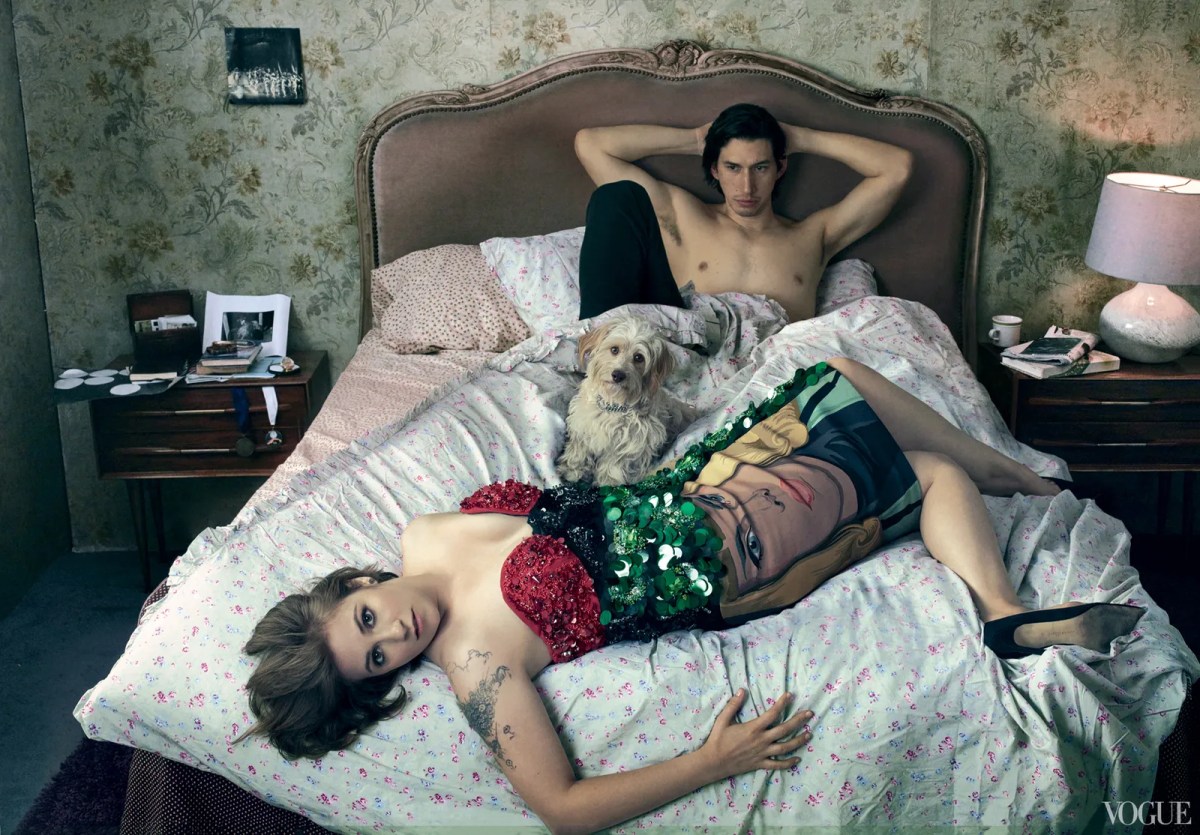
Unfortunately, one cannot prevent other people from sharing their reactions – if not to her work, then to her public presence. And you can swat away incidental remarks, but this Vogue-cover affair created a splash of diverse opinions, which were shoved into my face by my personal and public social networks.
The funny thing is that if it wasn’t for the chatter around it, I wouldn’t even know that the cover happened in the first place: I never bought a single copy of Vogue in my life. Moreover, I never even notice it on the newsstands. It’s not a conscious effort, but, come to think of it, my mind must be blocking it out – after all, this magazine and it’s kin are responsible for image crises of millions of women around the world.
But again, this “controversy” of Ms. Dunham’s image gracing the cover of Vogue was brought to my attention. And, as a life-long student of human psychology, I found the spectrum of reactions to this occurrence in itself to be quite a curious matter, which I’m itching to analyze. So, fuck it, here is my assessment of various opinion-expressing groups.
1. Lena Dunham’s acquaintances from her pre-celebrity life.
It just so happens that I am separated by a mere one degree from Lena Dunham’s former Oberlin College classmates (one of my client’s nieces), and I hear that these young women are absolutely scandalized by her success in general and the Vogue cover in particular. Apparently, Ms. Dunham was an undistinguished student. Moreover, she was “practically unnoticeable” (mind you, not unconventional, rabble-rousing, or irksome as a lot of real artists are perceived in schools, but simply unnoticeable) in the classes of her chosen major, Creative Writing. Outraged exclamations such as “She was Nothing, just unremarkable Nothing!” have been quoted to me.
Well, let me tell you: unremarkable she could’ve been, but she was never a Nothing. Obviously these socially popular and academically overachieving children of wealthy businessmen (now, by the way, all in post-graduate programs trying hard to better their job-market chances) didn’t bother to learn anything about their awkward-looking classmate. Lena Dunham has been born and will always remain a person with deep roots and vast connections in the artistic community. Do I really have to explain that in this world it counts for more than any kind of personal and/or creative substance?
You see that picture at the top of this post? That’s Aura Rosenberg’s 1997 portrait of Lena, age 11, as her mother’s, Laurie Simmons, artistic object – a dummy. How telling! Ms. Dunahm has been manipulated into the life she has right now since childhood. She always knew that her creative efforts, such as they are, will get at least some attention from her parents’ close-knitted network of artists, gallery owners, museum curators, screenwriters, actors, and, of course, PR professionals.
So, while the members of this opinion group were chasing top grades, prestigious internships, and references from esteemed literature professors, Lena Dunham didn’t need any of that – she was already writing her awful sketches for the “arty” web series, which eventually made her a MOMA (!) darling, as well as scripts for her self-directed and self-starred unwatchable shorts, which, despite their quality, were accepted for showing at indie festivals.
2. Inexplicably blind fans, who naively think that Lena Dunham is one of them – a college grad struggling through her life in a big city full of dull jobs, bizarro living arrangements, hopeless relationships, and fake friendships. Not too pretty or interesting, not too hard-working, intelligent just enough by the currently very low standards, and without any relevant life skills, yet feeling entitled to success and happiness. These pitiful creatures loooooove Tiny Furniture and Girls, they devour Lena’s tweets and voyeuristically follow her Instagram. And they went and shelled out $10 for the damn Vogue, because they mindlessly welcome every instance of public recognition of the person they mistakenly perceive as an “unlikely star.” Her very success provides them with a false sense of hope for their own future.
They are so self-absorbed and clueless, they didn’t even notice the familial loft (presently on sale by Lena’s parents for $6.25 million). They are not sophisticated enough to grasp the priciness of the clothes Ms. Dunham was wearing in the photos taken before she made a single penny. They already forgot about one of the first-season episodes, in which Hannah Horvath “worries” about her high school classmate who is going to Hollywood without having any connections. In their blindness these people are not much different from the first group – they have no clue just how privileged Lena Dunham is.
3. Starving skinny bitches, fashion zealots, and male chauvinists,who are having seizures every time someone who “doesn’t fit Vogue‘s image” is featured on the cover of the magazine: like Jennifer Hudson, or Adele, or Ms. Dunham. What can I say to these fucking assholes? Go and eat something – your brain screams for some sugar! You say, these women (I don’t care much for any of them, by the way) don’t fit the “beauty” standard, but Sarah Jessica Parker does? How about Kristen Stewart who looks in all dresses as if she is in drag? And in whose acid-induced hallucinatory trip Lady Gaga can be considered a “dream girl?”
Vogue covers have nothing to do with beauty, or at least they shouldn’t – they are supposed to entice prospective advertisers into buying space inside the mag. The trend-setting bullshit should be secondary to Anna Wintour – as a CEO of the business that is the periodic publication in her charge, her primary focus should be in increasing revenues. And it appears that she has been making terrible executive decisions.
The advertisers are interested in the number of eyes that will see their products and, like nowhere else, this book is judged by its cover: if they believe (whether right or wrong – doesn’t matter) that the celebrity featured on the cover will attract more readers, they will be fighting for the commercial space. Thus, Lady Gaga makes sense, so does Beyonce. Kristen Stewart while The Twilight was still a work-in-progress was an excellent business choice, now – not so much.
So, it’s a total mystery to me as a revenue-conscious CFO, why would Anna Wintour cancel Miley Cyrus’s December cover, while apparently “chasing” Lena Dunham for the January one. Let see: One is an international mega star who at her “mature” age of 21 is worth $150 million made primarily by her multi-platinum album sales and sold-out concerts (truth be told, I’m getting nauseous writing about it, but money talks). And the other one? A tiny auteur of a tiny movie with a tiny furniture that led to a tiny show.
Oh, don’t tell me it’s because of the “wrong message!” A fully clothed girl pretends to be sexual with a man on stage as a joke and that’s appalling? Wait a minute! Isn’t the other one is actually stark naked in most episodes of her show, frequently rubbing her bare vagina against her male co-star (for the sake of the show’s “emotional realism,” of course)? Ah, but over 10 million people watched MTV VMA – Miley made a big splash! An orthodox catholic priest Sinead O’Connor voiced her scorn all the way from her rural Ireland. So, the editor-in-chief chickened out! On the other hand, the last episode of Girls was seen by 830 thousand people – that’s safe. Well, the numbers speak for themselves – bad executive decisions all around, Anna Wintour, and skinny or fat makes no difference.
4. Cool-headed and reasonable, but unfortunately overly optimistic people. They understand very well what Lena Dunham is, how she came about, where her interests lie, and how much value her work has. Yet, they convinced themselves that the adoring people will eventually come around to their side, shed the blinds, and realize that they’ve had a temporary brain lock, or, at the very least, will get bored of the emptiness and repetitiveness. They believe that, just like much lauded by hipster media back in 2007 Diablo Cody (one of the 50 smartest people in Hollywood at the time, no less!), she will disappear into the mass of forgotten washouts.
Uh-uh, my friends! Lena is not going anywhere.
In the nepotism ridden Tinseltown Diablo Cody’s momentary success was a rare case of an outsider’s rise. She surprised herself with that ascent as much as she did the entertainment industry. Standing there with the damn statue in her hand she was speechless – she knew it was all about the hype and that she didn’t really deserve the Oscar (Ratatouille, not Juno, was supposed to win that year).
Have you watched Lena accepting her big and small awards? Have you seen her in interviews and in photo ops? There is an unmistakable sense of entitlement and belonging in her every word and move. She is gleeful. It’s not about deserving it for her. She knows she was born for this.
5. Confused liberal hipsters in a tireless search for social rebels and antiheros. They looked at Lena’s naked body and let themselves to be fooled into thinking, “That girl’s got balls; this is a feminist statement.” They truly believe that she is the “voice of her generation;” that she influences people (at least according to 2013 Time’s list). Moreover, they convinced themselves that Lena Dunham’s main human and artistic purpose is to fight their holy war for the right to be who they are and how they look. (Never mind that this representative sample is limited strictly to white, urban, college grads.)
These people are very disappointed. They feel like their idol has fallen. In their ardent fervor of feminist puritanism, they are convinced that the right thing to do for their “spokesperson” should have been to say to the devil-woman Wintour, “Thanks, but no thanks. You can shove your glamorous magazine and its cover up your skinny ass.” And they write about it at length: “Why Lena Dunham Should Say No to Anna Wintour,” and stuff like that.
It may be a wishful thinking on my part, but there are some signs that the size of this group of Dunham missionaries is shrinking. For examples, New York Magazine, the original (circa Spring 2012) herald of Lena Dunham’s coming as “the ballsiest,” the funniest, the most genuine, etc., etc., etc., has been absolutely silent for months about their former darling and her creations, making a single exception by placing an off-off-off-Broadway play that spoofs Girls via Little Women on the brilliant side of The Approval Matrix. Maybe some previously infatuated people start sobering up and finally realize that the only group Lena Dunham represents is herself. Who knows, of course? There may be another cover in the works.
6. Me, not surprised whatsoever. As Tyler Perry’s Madea said, “If someone shows you who they are, believe them.” (Thank you, the brilliant people who introduced me to that quote). So, when in the final scene of Tiny Furniture (Lena Dunham’s self-admitted movie about her life) she tells her real mother that she just “wants to be famous,” I heard it loud and clear. That’s the main focus, the life’s purpose.
And for the sake of achieving it, Ms. Dunham will do whatever it takes: Parody the explicitness of the true art revolutionaries by stripping in front of the camera whether it makes sense in the storytelling context or doesn’t (it actually did once – in the shower scene of Tiny Furniture); make politically correct statements, so appealing to the liberal media; pledge unyielding admiration and love to anyone who has some sort of pull. And yes, you only need to ask – she will pose for Vogue.
7. And then there is Kanye West… The poor man is terribly aggravated on account of his “friend” Anna Wintour selecting Lena Dunham for that cover instead of his Kim. He says that it’s not fair; that his Kim is “just as talented as Lena Dunham” (oh, she is, Kanye, she is – just as talented and far more popular). And by getting hysterical over this bullshit Kanye West unwittingly exposes how incredibly irrelevant the whole thing is. That’s the consideration? Lena Dunham or Kim Kardashian? That’s just funny.
Let’s keep it in perspective, people. In the grand scheme of things literally only a handful of people cares. Vogue has a circulation of 1.2 million. 1 million people follow Lena Dunham’s twitter, and apparently not all of them even watch her show (average 780,000 viewers). And yes, some of those who are aware of Lena Dunham’s existence hold media and entertainment strings in their hands. And maybe that’s all that Lena Dunham needs to be satisfied with herself, but intelligent people should know better: three months from now even the faithful perusers of Vogue will not remember who was on the cover of the January 2014 issue.