
Lena Dunham Claims Fame Makes Her Sick… Plus a Few Numbers

It’s like with all chronic irritants: just when you seem to forget about them altogether, something random will cause them to flare up… In a casual conversation Lena Dunham’s new memoir popped up. I wouldn’t know anything about it… But now… I got triggered. And you know how it is with mosquito bites—once you start scratching, you can’t stop.


It just had to happened, didn’t it?

It’s like with all chronic irritants: just when you seem to forget about them altogether, something random will cause them to flare up…

We were just talking about Beef‘s second season, my daughter and I. I remarked how shocking it was that the Ashley character was so obsessed with childbearing. An attitude rarely observed nowadays not only among gen-zers, but the millennials as well…

And that, somehow, prompted my daughter to tell me that Aubrey Plaza (six months my daughter’s senior) was expecting. With whom?—I wondered, since her husband passed away last year. Christoffer Abbott. Oh, he is cool. We saw him on Broadway in The House of Blue Leaves with Ben Stiller, Edie Falco, and Jennifer Jason Leigh back in 2011. He was also in the first season of The Sinner

...And Girls

As if I could ever forget! He is the one who left the show because he got fed up with Lena Dunham.

By the way—my daughter said—I just saw a clip of her on The Drew Barrymore Show. I don’t know why it was pushed to me. But some things she was talking about were quite…

Why, dammit?!! Lena Dunham—my personal symbol of undeserved attention and unrestrained nepotism! Please, stop!—I wanted to plea…

Yet… Why was she on Drew?—I asked. Is she promoting a new project? I mean, Too Much1 just came out last July… (I know because Netflix tried to push it on me.)

She wrote a new memoir…

All these tidbits are such peripheral, insignificant bleeps on the cultural radar. I wouldn’t know anything about them… But now… I got triggered. And you know how it is with mosquito bites—once you start scratching, you can’t stop. And now I am up to my ears in this…

The pushy dissemination.

My daughter shouldn’t have been surprised that Lean Dunham’s appearance on Drew was pushed at her after she decided to notice the news of Aubrey Plaza’s pregnancy. The actress starred in her late husband’s Jeff Baena‘s The Little Hours with one of the four Girls—Jemima Kirke. And there is zero degrees of separation from the future father. That’s how it works…

The only way we can stop the activity trackers from curating our content feeds is by quitting the whole online existence entirely. And there are probably brave and admirable people who do just that.

But I don’t think I have the emotional strength for such radical acts. I can bitch and moan about feeling like a fly stuck in the world-wide web, yet I continue to submit. And the stuff continues to be pushed…

Even Anna Wintour has soft spots.

Of course, I had to look up Lena’s book on Amazon… Just to see the title and the description. (I know, I know—we do it to ourselves, we do!)

Famesick… Ah, I see. Was pursuing her creative ambitions worth “all the pains of fame“?—she invites her readers to ponder… Fatigue, addictions, sex, and everything in between… The struggle is real!

Then, probably on the same day, I was on IMDb looking up the year The Prestige came out… It’s a regular thing for me. I am a cinephile…. Plus, I frequently feel compelled to rate what I watch… I’ve been using the site for decades now. Naturally, since Amazon acquired it in 1998, the interconnections became inescapable. I search for something on Amazon Prime and then I’m flooded with the ads for those items on IMDb.

This time, however, the sidebar invited me to checkout the collection of photos from Met Gala 2026—Fashion Is Art. Deep inside I knew. Of course, I knew. And there she was: in a feathery thing of the signature Valentino Red hue. Beyonce, Jay-Z, Rhianna… and Lena Dunham.

And that, actually, made perfect sense…

Truth be told, Lena Dunham has always had a good sense of style. As well as personal ties—cultivated through parental wealth and art connections—with haute-couture houses. But so are thousands of other people.

Did you know that Anna Wintour personally selects the 700 or so invitees to the Gala and approves their outfits? She’s been doing it for nearly 40 years now. And even though she stepped down as Vogue’s editor-in-chief last year, she still carries that particular responsibility on as Condé Nast’s Global Chief Content Officer.

Still, Anna Wintour—widely known as a demanding, exacting, and formidable media executive—has her soft spots too. They get softer when she is affected by strong PR, off-kilter cultural airs, and the liberal feminism…

She has always been partial to Lena, making Ms. Dunham probably the only memoirist and fringe movie-TV-maker to be a Met Gala invitee. In fact, I already wrote about it twelve years ago when Lena beat Kim Kardashian for the March 2014 cover of Vogue.

As per usual, a few numbers…

Let’s see… Since Amazon holds about 50% share of the printed books selling market and about 80% of ebooks, its data makes it easier for us to do some guesstimations.

The best selling rankings

The book came out on April 14th, 2026. Dunham’s publisher announces right there above the description that the memoir was an “instant #1 New York Times bestseller”. In non-fiction sector, of course. Definitely a certified hit. To make that rank a book usually sells about 3,000-4,000 copies a day in

all outlets combined.

I don’t know how long it stayed at #1, but in its fifth week, it was #5. So, the initial impact is diminishing. And it was listed as #3 in the memoir section of Amazon’s Charts as of May 18th. That translates into 1,500-3000 copies a day.

Let us be generous here. Let’s say that the memoir sold 4,000 copies a day for the first two weeks and 3,000 for the following three. That gives us total of 119,000.

The Amazon reviews

We can try to prove this number further. The book already has around 1,500 Amazon Reviews. Those can only come from verified purchasers. (Unlike Goodreads ratings that can be entered by anyone with a free account, whether they bought, read, or even saw the book cover.)

From the marketing POV, Amazon reviews are “engagements”. So, naturally there are statistical sales probabilities attached. The publishing industry consensus and author data indicate that only a small fraction of readers leave a review. Of course.

And the rule of thumb is the “50x multiplier”, or 2% of all readers. That gives us 75,000 copies sold in 5 weeks via Amazon. Still on the same wave of generosity, let’s say that it represents 60% of overall sales, yielding us 125,000 copies in total. Very close.

The royalties

I have experience with both the publishing-house (CFO Techniques) and the self-publishing royalties(I Built This Prison). So, let me tell you.

A publishing house, which carries the responsibility for production and marketing costs, usually pays author 10-15% of the list price of the printed books and 15-25% for the ebooks. We are going to go with the higher percentages. So, Lena’s royalties are about $4.50 per printed copies and $2.50 per digital version.

Believe it or not, people still prefer to hold a real book in their hands. Print books dominate with 80% market share. Multiply this and that: we come to the total 5-weeks yield due to Lena of $512,500.

Not I’m Glad My Mom Died, but, impressive for a niche celebrity memoir anyway. Not surprising, of course, considering all the PR efforts with the promo circuit that includes The Drew Barrymore Show and such.

And it also probably entirely irrelevant as I don’t believe that Lena Dunham would bother writing anything on spec2. Also, her agents wouldn’t allow that.

So, the advance...

I doubt, of course, that Random House would expose themselves again to the loss they experienced with Lena’s previous book Not That Kind of Girl. Back in October 2012—just three months after Season 1 of Girls ended—they got themselves into the bidding war, which they won with a highly publicized $3.7 million advance, hoping for at least 1 million of books to be sold. According to Nielsen BookScan, their expectations were fulfilled only by about 30%.

Understandably, the advance Lena received for Famesick wasn’t publicly disclosed at all. Nevertheless, we can safely extrapolate that she received at least $1 million at the contract signing. Less agents’ commissions, less taxes.

Still, a needful chunk of change probably. As I estimate that the residuals from Girls—still available for streaming on Max—are drying out by now. Considering that Ms. Dunham created, starred, and produced it, wrote about 70% of the episodes, and directed a third of them, they used to be quite sizable. But it’s been nine years since the show closed, so now it’s down to less than 2% of the original payout level.

…and my rhetorical questions.

Which I can’t help but ask.

What fame?

Of course “people” know her… In Hollywood and within New York’s arty intelligentsia circles. Especially among indie-obsessed cinema lovers such as yours truly. But what do you think the probability of a random person you stop on the street knowing who Lena Dunham is? Don’t even go to rural Nebraska—try the Bronx. I think it’s not very high. I dare you.

Actually, Lena always had a bit of an exaggerated take on her success. I remember back in the Girls days, there was an interview, in which she lamented about some TSA agent giving her hard time at the airport. She was actually expecting him to say something like, “Love the show”. I vividly remember my shock at her delusion.

The truth is, when Girls originally aired, the show’s viewership consistently averaged between 600,000 and 800,000 per episode. And I seem to recall that the latter seasons dropped to something like 300,000 viewers. I mean, there are 270 million adults in this country.

Of course, it would be ridiculous to compare such an intellectually introspective and socially esoteric show as Girls, aired on a paid premium channel, to mass-appeal broadcasting blockbusters. On the other hand, another HBO show, Game of Thrones —same time, same price—managed to draw over 10 million viewers per episode.

And here is another question:

If something really makes you sick, wouldn’t you try to avoid it?

I feel a bit bewildered here… I mean, if being “famous” puts you in peril, if it affects your existence to the point of having a deteriorating effect on your physical wellbeing—what the hell are you doing prancing in front of paparazzis in 5-inch heels? At the event that bills itself as “the world’s most prestigious and glamorous”, where “FAME, wealth, power, social influence” come together.

Of course, Ms. Dunham has been discussing, essaying, and scripting her mental problems since her college-years YouTube videos. And surely the bravery of exposing yourself to the world takes its toll… But was it really such a big deal for your immediate artistic circle of friends and family to accept your creative choices? I mean, nudity—both physical and emotional—has been a habitual subject of Art since the ancient times.

On the other hand—after the euphoria of the entertainment industry’s attention ebbed—Lena could’ve naturally fallen into a down cycle. Maybe she was actually missing the “fame”.

But damning fame is so much more compelling, isn’t it? Appeals to everyone. To celebrities—always struggling with various insecurities and such. As well as to the general public that welcomes anything proving to them they dodged the fame bullet… So ripe for pitching and marketing!

And are you all better now after channeling all that pain through your book? Is that what readers are going to find at the end? The hopeful start of the new chapter of your life? Really? Good for you!

But it begs the most important question now… And believe you me, I’m asking it with all the compassion of a person who can relate to many a mental problem. Especially those of the body dysmorphia, OCD, and self-harm kind (I called that Chapter of I Built This PrisonBuckets of Tears and Blood)…

Girl, what could you possibly know about real pain?

You rode into “fame” you blame for your ills on the coattails of your famous-artist mother and her network of such friends as Meryl Streep. And didn’t she finance your breakout Tiny Furniture? And also played herself in it? You gave her the second billing!

Very good mother by my standards. Two personal thumbs up from me. I mean it. In spite of my utter distaste for nepotism. (I’m torn like that: maybe she genuinely believed in her daughter’s merits, not just layering the yellow bricks for her spawn…)

Now, try to imagine starting off and striving on without that bulldozing PR machine you were born into behind you. Like many thousands of aspiring writers, filmmakers, and artists.

Contemplate opening your heart and pouring your troubled soul out onto the pages of your memoir, then go through the struggles of self-publishing, and end up living with one review. How would you feel then?

Yet, objectivity is my highest priority.

I honestly believe that Ms. Dunham is actually controlled by an unparalleled driving force within her. I think Miriam Cohen is right: Lena IS The Girl Who Perseveres. She will never give up. Pains of fame be damned!

And my initial hunch was correct, by the way: it’s not just the memoir. There are plenty of other new endeavors too. In on-screen entertainment alone, Lena Dunham currently has four upcoming projects. A movie genred as “steamy romance”, which she wrote and directed, is in post-production. It stars Natalie Portman, Mark Ruffalo, and Meg Ryan. Two TV series. Plus, another movie she will executively produced.

Two of these projects have the word “sex” in their titles. And one is still untitled. So, who knows… It’s all about the shock of Lena’s fantasies, isn’t it?

I probably will not live to see Ms. Dunham achieving actual artistic merit deserving the attention she gets. But I must say: that Valentino gown—just breathtaking… And so appropriately Lena! This is exactly what I imagine she can do: just wrap a giant boa around her naked body. Fabulous!


  1. In a typical outcome for practically all of Lena Dunham’s projects, the show garnered unduly kind critical reviews in such prominent US outlets as The New Yorker and Los Angeles Times. Yet, it had very moderate viewership and a mediocre 6.2 IMDb rating. A British reviewer writing for The Guardian was blunt: This pile of clichés, she said, amounted to “way, way too little”. Four months into airing, Netflix announced the show will not be renewed for the second season. ↩︎
  2. In hopes of success, without pre-existing deal with an advance. ↩︎

I Built This PrisonExcerpt: Ozark‘s Wendy Byrde Negotiates Her Compensation


I Built This Prison,  Part I – Etiology of Crime, Chapter 3 – Delusions of Entitlement and Misconfusion of Rewards:

“In the episode 1.6 of Netflix’s original ‘Ozark’, desperate for money Wendy Byrde charges at her boss with an attempt of hostile earnings renegotiation (she is a pushy bird that Wendy Byrde, so it goes with the character). She notes that the sales are up 43% compare to the same month the previous year, while the only business change that took place was her hiring. Hence, she deserves a bonus that would correlate her compensation with her value(‼). Specifically, 50% of the income increase. They haggle and at the end the boss agrees to the bonus that together with Wendy’s salary amounts to one-third of the additional profits.

Fiction, of course. But, if the employers were actually inclined to evaluate and compensate their employees based on their tangible contribution into their businesses, the negotiations like that would be a common place. And maybe they are… somewhere. But I’ve never really witnessed anything like that. Well, something of the kind – once, fifteen years ago. But that was it.  

Of course, these are not exactly “negotiations” either. Wendy gives her boss an ultimatum because she has an upper hand – there is no comparable supply of labor in that God forsaken bumblefuck locale. There is like literally no one to do the same job – not on a half-ass, or quarter-ass, or even one-hundredth of an ass level. And so, her boss is not rewarding her for her contribution, he yields under the pressure of unfavorable market conditions.

An unimaginable situation for NYC (and I’m sure the same goes for all industrial centers), no matter what your field of expertise is! Here, an employer – even the one that is afraid out of his mind to lose you – deep inside knows that if you walk, he can find at least Somebody to fill the void. You, on the other hand, may drown in the competition searching for another place.”

                                                                                                                          p.40

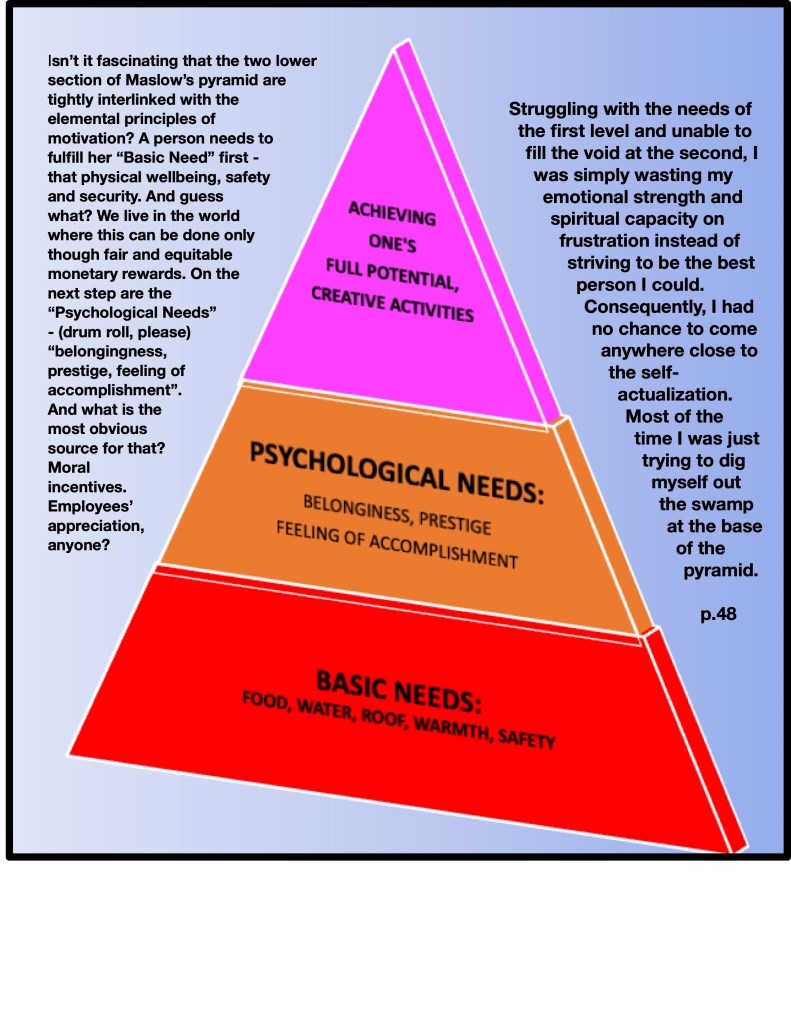
I Built This Prison: Teaser #4: Maslow Hierarchy of Needs for White-Collar Employees


I Built This Prison: A Memoir of Rage, Revenge, and Repentance


NOW AVAILABLE ON AMAZON

“What are you doing here?” was the question everyone asked me in prison – the guards, the inmates, the civilians. They didn’t think I belonged behind the barbwire and couldn’t imagine me doing anything criminal… I just seemed so fundamentally out of place there…

In a way they were right: under our contemporary standards of morality, for most of my life I was viewed by all as an upstanding citizen. Yet, my imprisonment was well deserved: After devoting 25 years of my immigrant life to staying afloat as career Controller and CFO in the unforgiving environment of private entrepreneurship; channeling my various frustrations through this blog for as long as four years; and writing a CFO guide for Springer – I began stealing from my employer, embezzled millions, and got caught… 

What happened? How could a fairly decent person with strong moral beliefs and exceptional work ethics get transformed into something that repeatedly committed one act of thievery after another? Disappointment and  resentment overwhelmed all coping mechanisms and deteriorated into cunning deception. The depletion of personal means coincided with the overflow of the corporate profits… The distorted mind found the way…

My story is very particular and acutely personal, but in many ways it’s also quite typical… Because this memoir was conceived out of my need to repent, I strived to be honest and as objectively revelatory as I could, unflinchingly analyzing the genesis of my moral degradation and its psychological underpinnings. The book also details the specifics of this white collar crime and reflects on the different stages of its aftermath, depicting my quest for some inner clarity under the most oppressive conditions, in the grittiest of places…  

The result is part chronicle, part cautionary tale, part heartfelt confession, part inquisitive commentary… And I sincerely hope that the readers will find my conversational style compelling enough to forgive the verbosity…


The Struggle Is Real for Employers As Millennials Enter the Workforce with Their Own Value System


Like many hiring execs, I still have an employer account with Monster.com, even though the time when they dominated the job-hunting market has passed.  Nowadays, they are not even at the top of the industry leaders list.  Still, we got used to them in the 17 years they've been around.  And they do try their best to provide the paying clients with value-added bells and whistles beyond the standard ad posting:  resume matching, database searching, description writing, HR Resource Center, and whatnot.  

Pouty ShirleyOne of these add-ons is the email service that blasts recruitment articles to all registered users.  I usually ignore these emails, but the last one had an article with an enticing title The Real Reason Millennials are Leaving Your Company.  

The first thing that caught my eye was the singular "Reason."  I thought, "The author was able to identify a single, most fundamental cause of what appears to be a case of chronic pins and needles in the millennial butts?  That's remarkable!"

I got even more curious reading the logline.  It talked about an abundance of options, "a plethora of jobs" that allow millennials to be "super selective" in their career choices.  Moreover, it promised expert advice to employers on how to keep the "valuable millennials" in the work seats.  I was like: This must be one of those sci-fi imagine-if humorous thingies, because these statements, if not drenched in undiluted sarcasm, can only refer to some remote planet in an unknown universe.  Here on Earth, right now, most of the millennials you and I know are either unemployed, or work jobs that have nothing to do with their chosen professions (let alone vocations), or stretch their schooling to avoid facing the bleakness of the job market.  I mean, there are premium cable shows and broadcast sitcoms about it.   

And, "valuable millennials?"  Yes, they exist, in small numbers and tiny clusters, and you ought to be very lucky to have them around.  But generally speaking: the state of our arts and entertainment is a testimony of young people's value and their values.  And when it comes to hiring, you need to go through 800 entry-level resumes to find 3 candidates who can write a coherent sentence, even though (I'm talking to you, senator Sanders!), all of the applicants have college degrees.     

Opening the article immediately dispelled all enthusiasm.  Firstly, no pinnacle reasoning was crystallized.  The piece was divided into subsections addressing different causes for millennials' job mobility.  Since the author is not a Canadian afflicted by the national inability to pluralize words, I can only attribute the use of the single form in the title to writing and editing sloppiness.  And, of course, there was not a single whiff of alien or any other humor.

In fact, the self-branded Talent Maximizer® Roberta Matuson, who wrote the article, takes herself and her "advisory" role very seriously.  In complete solemnity she lists the following as the reasons why the millennials don't want to hold on to their jobs (with my commentaries):

  • Millennials want to work for companies that help to improve society.  Ms. Matuson suggests that those employers who want to retain Millennial workers should "take a closer look at the organizational purpose," assess how the company's mission impacts society, and redefine its purpose.

To paraphrase Woody Allen, "What's wrong with this?  Everything!" 

First of all, what does the lame formula "improved society" mean?  What's a "better society" for one person, is hell for another.  The massive support of Bernie Sanders by young voters clearly shows that they want to live in a welfare state.  I, on the other hand, have been preaching no government interference and market economy my whole life.  I would understand if the focus was more specific – let's say on environmental issues.  If employees of different ages boycotted the fracking industry, for example, our society would seriously benefit in the long run.  But I doubt we are talking about future impact here.  I'm pretty sure that if the fracking industry started providing free daily lunches to local people, the millennials would think of them as employers with a positive mission!  Never mind the explosions and the fiery faucets.

And what happened to the old-fashioned purpose of being profitable, staying in business, and continuously providing jobs?  It's not good enough?  Do all millennials want to work for non-profits spending grants, or public companies depleting investors' pension and college funds?

  • Millennials need constant external motivation: nurture, praise, repeat.  A shout-out here, a lunch with a boss there, or an invite to an off-site event, Ms. Matuson suggests, will help to demonstrate that the employers care.  Otherwise, the millennials will leave, because "the recession is over."  

Well, this is not the first time I am confronted with the suggestion that what I call "hugging motivation" is more important to younger people than fairness, objectivity, professional growth, adequate compensation, etc.  Don't get me wrong, the acknowledgement of one's achievement is incredibly important, but only if it's deserved.   Constantly patting on the back some unimpressive, low-value jackass out of fear that they will leave – that would be a betrayal of my work ethics and a violation of my fiduciary duty as a CFO.  Merit-based rewards, people!  That's what made America great in the first place and that's what will bring the greatness back! 

And here she goes again with the sci-fi twist: the recession is over!  Where?  In Alpha Centauri?  Oh, wait – on the front page of The Wall Street Journal and in government reports.   In real life, we are in the permanently recessive stage of economic decline with no prospects for upward turn.  This slow sliding may feel to the uninitiated as a flat plateau, but just you wait - we are bound to experience some dramatic crashes as well.

  • (Brace yourself for this one, cause contrary to the previous statement:) Compensation is important to millennials, especially if they have student loans.  "If you don't pay the millennial whatever he or she thinks they are worth," they will leave.

So, no matter how much you praise them, and hug them, and take them to lunch, the old-school paycheck still matters! Except there is nothing old-school about it either.  Back in the day, wages were determined by clear and tangible factors: the sophistication of the job, the level of expertise, the scarcity of QUALIFIED professionals on the market.  But apparently it doesn't work like that with the generation of people who were born after The Breakfast Club and Back to the Future came out.  The key to their adequate compensation is their own self-worth.  We must pay them whatever they think we must pay them.  And don't forget, the employers need to account for the student loans!  Essentially the implication is that we have to pay them what they NEED and not what they earn.  "From each according to his ability, to each according to his needs" maybe sounds right to Sanders's supporters, but it is not the principle that lies in the American foundation.  You know whose principle that is?  Marxists-communists!

  • Millennials require work-life balance.  

Just the millennials?  Is that what the article's author actually believes?  That millennials should be treated preferentially when it comes to working hours, paid time-off, etc.?  That there should be two different HR policies in every company, one for millennials and another for the rest of us chickens?  That's age-based discrimination, isn't it?   

I've always believed in the importance of work-life balance and regularly wrestle with the owners to ensure that every employee has access to the same set of benefits and perks.  And what my experience shows is that the millennials take the full advantage of these packages like no one else; sometimes to the point of abuse.  90% run out of the office the minute the clock strikes the official end time, no matter what's happening with the work.  Many don't even spare a few seconds to shut down their computers (yet all of them fancy themselves "environmentalists").  Just last year, I had a millennial employee who was out for 15 working days in the 5 months I tolerated her bullshit.  I've never had to deal with that kind of attitude before the millennials entered the workforce.         

The truth is that you don't need to be an HR expert to formulate your ideas about the reasons behind the millennials' prevalent job discontent.  Any experienced manager with a keen eye and some human insight can draw up a comprehensive list.  And here is mine (in no particular order):

  1.  Many millennials, especially liberal arts majors, have a hard time defining their purpose and developing a sense of belonging at a job.  This is primarily because they go to college to learn… nothing.  I'm not even talking about slacking and partying.  There are so many narrow-niche bullshit "liberal arts" degrees out there, most bachelor graduates acquire no practical knowledge.  And it makes thinking of a career path very difficult.
  2. Much scarier, they are not equipped with any basic learning skills.  They can neither study on their own, nor operate with minimal supervision.  Not able to absorb new knowledge, they feel like failures and will eventually leave for an "easier" job.
  3. Turns out that the damned phone is a millennial Achilles heel.  The millennials are so used to texting, tweeting, and posting, 85% of them are afraid of talking on the phone.  When confronted with a job that entails constant voice-to-voice interactions, which are a plenty,  they opt to quit.
  4. Aside from athletes and health freaks, young people nowadays live incredibly passive lives.  Some people say that the abundance of streaming content is to blame, but we all know that way before YouTube (2005) and  Netflix's streaming (2008), young people were already glued to their computers and game consoles.  Thus, they suffer terribly on the jobs that require them to be out of the office most of the time – selling, pitching, servicing, etc.  According to some HR professionals, this is one of the millennials' biggest complains.    
  5. The bulk of this generation grew up with no discipline or structure, both at home and at school.  While being a non-conformist is an invaluable quality when it comes to independent thinking and artistic expression, in a survival-driven business environment the lack of self-control, inability to follow rules of conduct, and disregard for subordination can make one's life pretty unbearable. 
  6. They want to be hugged and cuddled all the time.  Many of them crumble under pressure and cannot deal with reprimands.
  7. I know it sounds like a cliche at this point, but it is true – they do want trophies just for showing up, because that's what they are used to.  As a result, they develop a clinical deficiency of self-motivation for achieving merit-based recognition.  They shy away from competitive environments where hard work and achievement translates into tangible rewards of raises, bonuses, and promotions.
  8. Celebrity-saturated social media made the majority of millennials into unsettled zombies who are preoccupied with fantasies of becoming instantaneously rich and famous.  I guarantee that the star-struck ones will continue moving from one job to another, feeling extremely discontent.   
  9. The majority of the millennials are not prepared to be self-reliant.  The livelihood of many a chronic quitter usually doesn't depend on their own paychecks; they expect to be continuously supported by their parents.  
  10. And some young people, just like in every generation before them, are restless because they want to be adventurers; they are afraid that Life will pass them by.  The boring job can wait; while they pursue their dreams.  And, of course, sadly, most of them are confused, and don't know what they want, and don't have any ideas, or talents, or clues.  But let me tell you: that is the only good reason to quit your job (assuming you can afford it).  All the others are just weaknesses and incompetence.