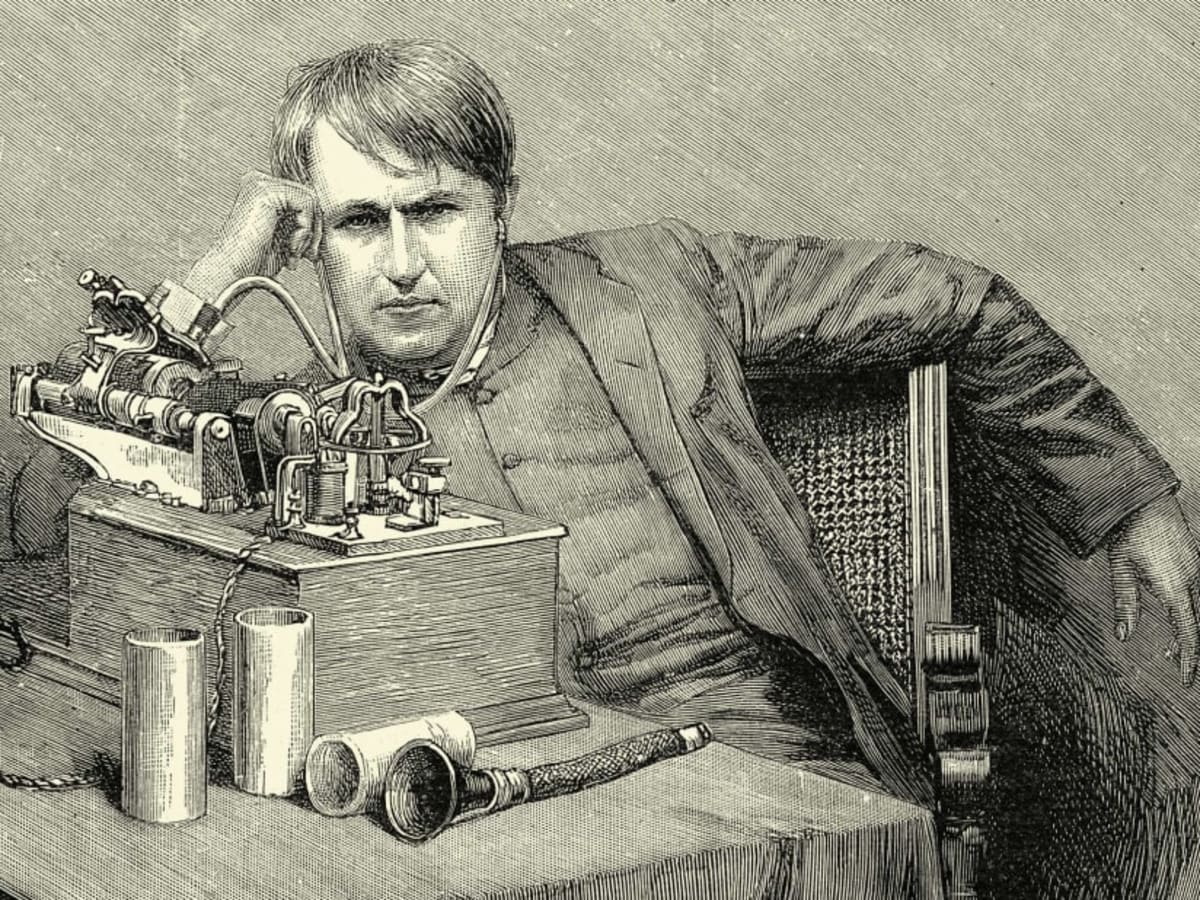
“We don’t know a millionth of one percent about anything.”
Thomas Alva Edison
“We don’t know a millionth of one percent about anything.”
Thomas Alva Edison
Oh, boy, World Wide Web! You are 25! So young, yet so much happened to you already! You are like a fucking child rock star!
When you were born, I was still in my 20s; so were Madonna and Michael Jackson; Brad Pitt was 25 (he just turned 50 – the jury is still out on whether you are good at math or not). Now I run to you to roll time back and see people who witnessed your birth being young and alive – you keep them all and more inside your multitude of brains.
In only a quarter of a century that flew by with incredible acceleration you have spread yourself wide and deep. You became a source of memories, references, entertainment, political battles, nationalistic agendas, a wide range of freedom and "freedom" fights, and the supreme motherbitch of it all – communication. Oh, the connectivity of it!
Just like other immature tech moguls born in the eighties you strive for world domination without any care about what you have and will destroy on your way to that lofty goal. Just like them, you carelessly offer your services to those who uphold personal liberties and those who do whatever they can to extinguish them.
Talking about mixed emotions! On one hand, it seems that I cannot exist without you and I don't even want to remember how I managed, oh, so many things before you were born. Hey, you gave me this very outlet of self-expression! On the other hand, I think you are a source of some major-scale evil; you made everyone more stupid; you will accelerate further retardation of minds and degradation of humanity – all before you exhaust your own sources of existence (aka energy and servers' capacity) and bring life functions that rely on you to a grinding halt. So, as much as I need you, I still keep my Britannica; I still buy hardcover books, CDs, and Blurays; and I still write checks. I use you, but I don't trust you. If I look closely I see that you are a sneaky creep.
What can I wish you on your 25th birthday? What can you wish anyone on their 25th birthday? To become a mature and responsible adult. You go and figure out what it means. I still didn't.
Sometimes when you open a certain topic, it becomes hard to move on to the next one. So, again about bankers and genders…
When we hear the word "discrimination," the first thought that comes to our mind is "unfair." Indeed, in it's most common definition of the last 150 years, discrimination is understood to be an unfairly different treatment of a specific group of people. We think: race, ethnicity, gender, social class, origin, sexual orientation, wealth, etc. This is the type of discrimination that I just fucking hate. And I am not saying this to be politically correct: I truly am a serious opponent of an inequality based on anything other than talent and merit (please keep this in mind as you read on).
People forget, though, that the word "discrimination" has a much older meaning and can be defined generally as a "recognition and understanding of the difference between one thing and another;" frequently even more specific: "the ability to discern what is of high quality." Truth be told, under this definition I have discriminating tastes – in many things, but especially when it comes to judgments of people. Particularly, when I have to act as a hiring manager.
I discriminate against dullness, stupidity, and narrow-mindedness. I've mentioned it many times in this blog's posts and I spelled it out in the Human Resources section of CFO Techniques: what I really look for in the eyes of a job applicant is a sparkle of intelligence.
Because of that, I find myself discriminating against a very specific group of people, namely men with a banking background. I try to refrain from generalizing – it could be my own unfortunate experience with this occupation, but, from my point of view, it is largely populated by male bankers who are limited, slow, and intellectually lazy.
Nowadays, the term "banking" signifies so many different things – every major institution dabbles in several "satellite" industries: investment banking, all sorts of trading brokerage, insurance, etc., etc. So, to avoid the confusion let me clarify that I'm talking about the plain old conventional bankers, whose job is to keep the excess of your funds in their "vaults" and to sell you money when your needs exceed your availability. These are your commercial loan officers, relationship managers (RMs), business development VPs.
And, of course, these are primarily men, who are not motivated to rise above their genotype. Why should they? They've got the upper hand by default. Women must claw themselves into the tight boy's club. If they succeed in doing so, they are not only eager to do a good job, they also move to the more sophisticated areas and specialties: treasury management, foreign exchange, trade finance operations, investment banking, etc.
Back in the day I used to blame the inertia of male bankers on liquid lunches: 20-25 years ago they literally worked from 9 am to 12 pm in the office. Then they would go out for lunches, with clients or with each other, order martinis, and from that moment on the drinking wouldn't stop until evening. Being intoxicated obviously doesn't make anybody more alert, expedient, or add urgency to one's attitude. But this banking trait was squashed long time ago – the liquid lunches went away, yet the quality of work remained the same. Maybe they stopped drinking on the job, but the productive hours remained the same - and it's just so much you can do between 9 and 12. But are they awake even during those three hours?
I went with one of my clients (a wiry, fast-talking businessman, who still wins sprinting competitions in his age category) to a meeting with his RM from PNC Bank. I swear to God, this banker exceeded even my expectations: he epitomized the idea of an "empty space" and he seemed to be half-asleep. I got a distinct impression that whatever we were saying to him literally entered his left ear and immediately flew out of the right one. After the meeting I tried to warn my client – I said, "Your Credit Agreement just started. Before it's too late, please try to ask for the RM's replacement. You will not be able to work with this guy. You are going to hate him." He didn't think that he needed to bother with such "trifle things." Now, two years later, at least once a week I hear, "Oh, my God! I cannot stand that guy! I cannot deal with him – it's like he is in a coma."
Coma! That's even worth than half or fully asleep! Yet, it is true. I always complain about the lack of urgency in the majority of workforce everywhere, but for this group of institutional employees it's an epidemic. Here is something from an email exchange between my other client and his RM (with copy to me): "We initiated this matter with you last summer, almost 6 month ago, and it is mind boggling to me that you could write today that you 'are still in process of writing up the formal approval.' Ironically, the only related matter for which the bank had no hesitation to proceed post-haste was to deduct legal fees that appear unjustifiable from our account." Do you sense the level of frustration?
But lethargy is not even the worst of their traits. Sometimes I wonder if these people are specifically picked to be so, for the lack of a better word, unimaginative. I was talking to this one banker recently about his client, explaining how important it is for the company, which deals in bulk liquids, to lease tanks near Georgian ports: when a shipment arrives a hose can be hooked directly from the tank to the vessel and the product can be pumped out at a minimal cost. A couple of days later he writes to me: "I remember you said they had a tank in Atlanta…" Atlanta? I laughed out loud. It's fucking 250 miles inland! Some hose would that be! On the other hand, he is a banker in NYC – Atlanta is probably the only city in Georgia he remembers from his geography classes.
It couldn't possibly have always been like that. In the old times conventional banking was entrepreneurial, risky, dangerous business. A banker who took your money into his safe kept his gun in the holster under the jacket at all times and used his shrewdness and guts in determining whether you worth a loan or not. And yes, he would hire a meek dude for the back to count money and keep books. And that guy needed to be meek, so that he would be too afraid to steal. But even that quiet mouse had to be nimble with his fingers to count money and he had to have quick reflexes to be able to duck for safety when the shooting ensued.
That's it, isn't it? It's the cancerous growth of the banking business into these giant monsters that we, corporate financial executives, are forced to deal with now. They are too fucking big and they need to fill all the seats, so they hire entry levels straight out of colleges (out of specific colleges on their specific lists) as long as they meet the GPA and internships criteria. And nobody is looking into their eyes: are there any sparks, or they are just good at memorizing textbooks for a hot second and taking tests? After that it's a hit-or-miss game: the brightest go for stars and big money, but more routine tasks go to the dullest contingent. And they do that for years: sitting in the same positions, performing the same limited tasks; without the necessity to develop new skills or mental abilities; slowly crawling up the long ladder according to their tenure, never reaching real intellectual heights before their retirements.
It seems, however, that some of the more entrepreneurial banks have finally started realizing that they are being drowned by the incapable, half-asleep, idiots, and they are trying to correct the situation. As I said in my February 20th post, the number of women in the relationship management is increasing exponentially, and I just met two people who came into institutional finance from M&A. Well, good for the banks then. But if they don't want to hire (or keep) the industry-grown nincompoops, why should I?
Those who have read it may remember that I specifically noted in that post that the possibility of diminishing number of the Confused Liberal Hipsters who misguidedly uphold Lena Dunham in high esteem as their feminist hero can be just my wishful thinking. Still, I feel obligated to tell my readers that yes, indeed, it was nothing more than a momentary slip into an illusion that people may be getting a little bit less stupid.
I cited New York Magazine's long-time silence about Girls and its creator as a hopeful sign. Well, I spoke too soon: In the current issue The Approval Matrix placed that (I mean the image in the picture) on the Brilliant side.
Then again, they might've been sarcastic… Like in, "brilliantly exploitive and shockingly repetitive," or something? You never know nowadays – hipsters don't possess genuine humor. Thanks, Tina Fey! And guess what? See the article below.
Related articles
"And when the sabbath day was come, he began to teach in the synagogue: and many hearing him were astonished, saying, From whence hath man these things? and what wisdom is this which is given unto him, that even such mighty works are wrought by his hands?
Is not this the carpenter, the son of Mary, the brother of James, and Joses, and of Juda, and Simon? and are not his sisters here with us? And they were offended at him.
But Jesus, said unto them, A prophet is not without honour, but in his own country, and among his own kin, and in his own house.
And he could there do no mighty work, save that he laid his hands upon a few sick folk, and healed them.
And he marvelled because of their unbelief, And he went round about the villages, teaching."
Mark 6:2 – 6
The Frustrated CFO comment:
Philosophical and belletristic powers of biblical stories lie in their proverbial precision and universality. It's no surprise that people frequently use phrases that became ingrained into our common cultural consciousness without even knowing that they are quoting the Bible.
In this particular case, many use a simplified version (No man is a prophet in his own land); others put it into their own words ("He was a dreamer, a thinker, a speculative philosopher… or, as his wife would have it, an idiot" [Douglas Adams]) – but the truth remains: People who know us privately, who observe us growing up or growing old, who see us in our house robes and undies, who bring us tissues and teas when we are sick, cannot appreciate us for our achievements, even if they enjoy their fruits.
Great men and women are frequently treated carelessly by their siblings, long-time friends, old neighbors, spouses, boyfriends, and girlfriends. I frequently hear stories told by various business owners and executives about their children who have no idea what their parents do, don't care to find out, and treat them as if they were some silly schmucks. Scary people who control fates and well-being of numerous entities and their employees around the world are made fun of at home. My own daughter rarely shows any respect to me, but will admire and listen to other people.
It takes someone as objective as I am to acknowledge an extraordinary person in someone very close. Alas, it's an impossibly rare exception to the common rule: one will not get honored in his/her own house.

 The Frustrated CFO