
Off the Cutting Room Floor of I Built This Prison: Clip #1: Authorship Under Employment


It’s not just your basic human rights that get clipped. You know the inherent copyright rule that everything you create is yours? Not if you created it within your employment framework. As hired help, we lose any and all forms of authorship. Whatever we develop, design, formulate, innovate, write in a normal course of our paid work responsibilities belongs to the compensator. The re-using or duplicating your own prior achievements in any other business can be subject to litigations, which, at best, is throwing money into the wind and, at worst, will ruin your life.

Here’s a classic pop-culture example that can make it clear for everyone. In 1982, Tim Burton, then employed by Walt Disney Feature Animation (a subsidiary of Walt Disney Studios), wrote a poem titled The Nightmare Before Christmas. Being who he is – I mean, an incredibly talented visual storyteller – he considered various possibilities of translating it into images: a TV special, a children book… He created the concept art, the storyboards, and even got Rick Heinrichs (a production designer on many subsequent Tim Burton’s projects, as well as both Ghostbusters, all Pirates of the Caribbeans, etc.) to sculpt the character models… But Disney of the time (CEO E. Cardon Walker) deemed the project too “weird” and stalled it… Then, in his two-year stint as Disney’s CEO (1983-1984), Ron Miller was more interested in creating the Touchstone, which allowed Disney to develop “grown-up” movies, than in Tim Burton’s beautifully morbid ideas – he fired the auteur in 1984.

Thank God for that, because in the next eight years, Tim Burton went on creating Pee Wee’s Big Adventure, Beetlejuice, Batman (all for WB), and Edward Scissorhands (for 20th Century Fox). Yet, the quasi-autobiographical turmoil and conflict between the strangeness of character and the desire to fit into the spirit of a “happy holiday” (never mind that it’s Halloween) that he conceptualize for Jack Skellington have never really left Burton’s creative horizons. Around 1990 he checked… And guess what? Disney still owned it. And by then it was already a Michael Eisner and Jeffrey Katzenberg’s domain with the turf fertile for producing a full-feature Nightmare.

Oh, of course, they gave Tim Burton the creative credit – as the story and characters’ developer. And they listed him as a producer… Why wouldn’t they? His movies were already commercial and critical successes – the instant cult classics that, nevertheless, generated box office numbers in multiples of their budgets. Who wouldn’t want to smack Tim Burton’s name on a billboard? But it’s not like he could take this child he conceived and labored to birth – his creation, and take it away to some place where he could nurture it. No… It was fostered now by people with no blood relations. They even didn’t want to wait until the birth parent was free to play with it (he was committed now to Batman Returns at WB)…. They hired their own nannies from within – a screen writer (Caroline Thompson) and a director (Henry Selick)…  

Don’t get me wrong: I love The Nightmare Before Christmas the way it ended up to be – the stop-motion animated musical with genius music and voice of Danny Elfman. Still, for 30 years now, I’ve been wondering: What it might’ve been if Tim Burton’s parental rights were not terminated by the fact that he was paid a salary by Disney at the time of the authorship…

And as I said, the same rules apply to all achievements attained by a paid employee under the constriction of employment. Whether it’s a product – either creative or physical, a formula, a solution, a process, a recipe, a construct, a logarithm, a program, an optimization matrix, an analytical macro, or a KPI dashboard – it does not belong to you just because you created it. It’s in the possession of the people who paid you your wages. They are the ones who get to use and reuse it, whether you are still attached or separated from them.”

                    Deleted from I Built This Prison, Chapter 4 – Bucket of Tears… and Blood    
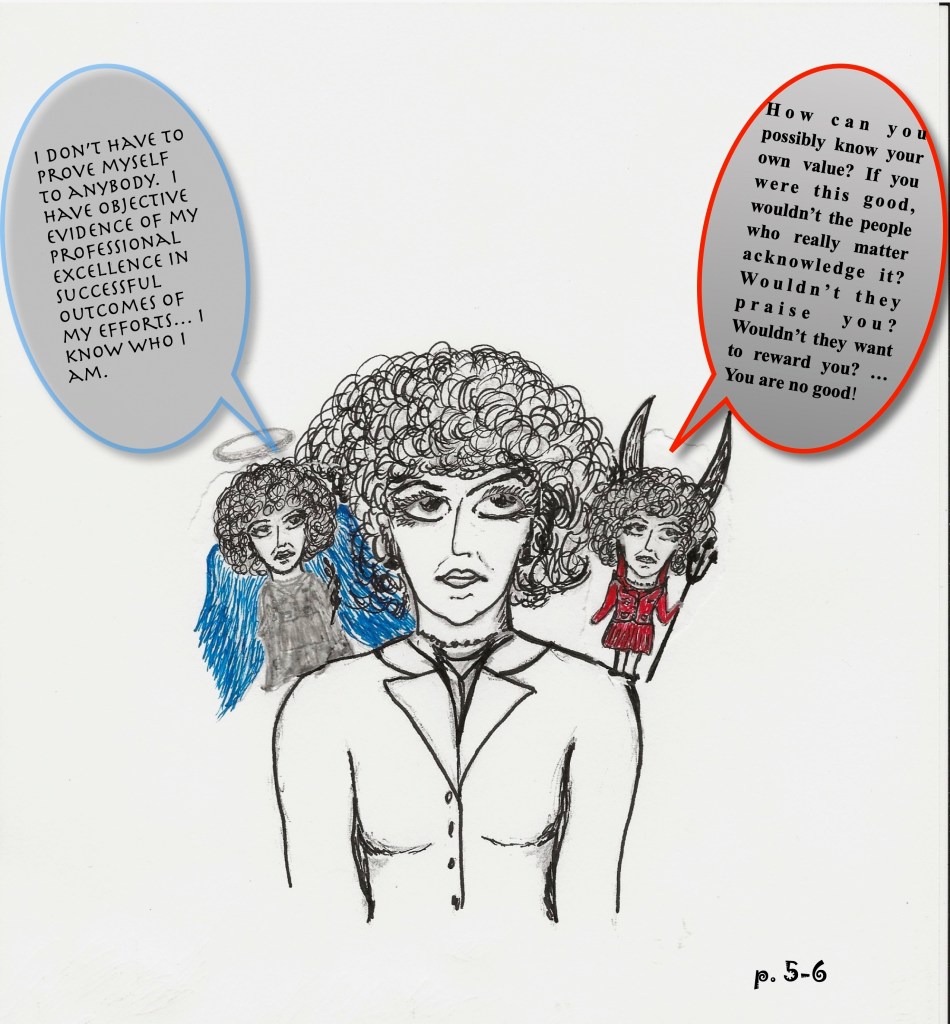
I Built This Prison: Teaser #2: That Battle of Good and Evil Within


I Built This Prison: Excerpt: High Achiever with Low Self-Esteem


From I Built This Prison, Chapter 1, Pride Desperately Seeking Validation

“…I used to think of my unhappy self as some sort of a special brand of weirdo.  And in many ways the circumstances that have shaped my life were very specific.  However, the tangible outcome, the resulting state of mind – that yearning for validation – and not by everyone, but by a particular someone – it is not unique at all.  In fact, many people live the same daily struggle and suffer the overwhelming despair that comes with it.  

Since the moment I accepted that I have a problem and began examining my own condition, I started seeing it in others as well…

…Various forms of this desire for one’s value to be acknowledged and appreciated by the specific people we anoint as our yardsticks can be traced all the way to biblical and mythological sources. “Father’s blessing” as a token of love and recognition is at the center of practically every single sibling rivalry in Genesis, Greek mythology, and Norse lore.

♦♦♦

Despite its relative commonality, it’s not easy to define this condition in one straightforward formula. It’s full of paradoxical qualities.

For example, one of the most prominent common denominators among people who suffer from the rift within their self-image in the same way I do is the drive for overachieving. In spite of the deep, dark emotional abysses inside, on the outside we go out and display the superior levels of functionality.

It’s easy to confuse low self-esteem with the lack of confidence. Even some dictionaries explain one’s meaning with the other.  But they are, by far, not the same. Somehow, being absolutely clear about the extent of my capacities and striving to fully utilize them have always coexisted in me with thinking of myself as utterly worthless. In fact, the awareness of the merit I invested into my accomplishments made my craving of the acknowledgement that much more intense.

This malady is a bizarre cocktail of contradictions. It definitely paralyzed my aspirations and stunted all impulses of positive daring, but conventionally I was doing just fine. I still went about being a straight A student, acquiring multiple academic degrees, expanding my professional expertise, positioning myself at the executive level of the companies that hired me.

It’s like a dual-action trauma: on one hand, I was pounded into the chasm of neglectful diminishment; and on the other hand, I was motivated to swim up and out…”

♦♦♦

Beyond my parents “…my recognition-thirsty psyche… fixated on the worst option possible: my bosses. Granted, I’m not talking about some middle-management hired hands. At the very beginning of my professional career back in the 1990, I made a conscious choice of advancing it in the precarious environment of flat-structured, privately-held, owners-ran companies. I’ve held Controller and CFO positions since 1993 and I’ve never had any layers between myself and the Founder/CEO/President. It placed me and my efforts into the spotlight held by ‘the only people who mattered’ – the ones directly responsible for my appreciation and rewards.

A totally unbalanced logic led me to seek and expect (!) approval from these little Napoleons, the tiny kings in their kingdoms, the self-made entrepreneurs, from whom I chose to accept employment. It is mind-boggling that, even though I usually managed to quickly identify their professional shortcomings and human deficiencies, I remained completely blind to the futility of my hopes to be assessed by them in accordance with my merits.

Nietzsche saw the conscious understanding of one’s value as a natural distinction of someone with a ‘master’ mentality. And he attributed a man’s ‘waiting of an opinion about himself’ to the concept of a ‘servant’ mentality. He called the latter an ‘immense atavism’, implying that it belonged to the old times, when the society was clearly divided.

No matter who we are, when we submit into Employment, we are forced to adapt ourselves to the idea of servitude. And in some of us, it clashes terribly with our true identities.

♦♦♦     

Naturally, the continuous mental battle between the two modes of existence – the one, in which you know your value and are recognized for it, and the one, in which you are ignored and mistreated by those who matter the most – builds an incredibly debilitating pressure inside. This constant back-and-forth switches between someone’s recognition vs. someone else’s disregard, make you sick – and I don’t mean dizzy.       

My agitated mind needed to defend itself in one or another way. While I consciously refused to admit to myself that I had a problem, my subconsciousness has built a defense mechanism all on its own: It learned to seek comfort in the familiar groove of misery carved into my psyche by the repetitive escapes into the dark corners of depression, anxiety, self-loathing, and self-pity.

Just like a gramophone needle, I would drop into this loathsome rut and let myself run, and run, and run in it. And then again, and again, and again…  Every time I felt hurt by one or another situation, a word, or someone’s action – big or small, didn’t matter – I would habitually seek solace in an emotional state most psychiatric professionals would consider highly problematic.

I guess, my depression symptoms have always been somewhat plain to see, because even my primary physicians would suggest a medication. I’ve been on one or another anti-depressant and anti-anxiety pill for some stretches of time since I was 18 years old.  And then I’d stop taking them for the periods just as long.  Sometimes, for very legitimate reasons – like when I was pregnant. And sometimes I would quit for no reason at all. Probably, because I didn’t want to think of myself as crazy or weak.

But you see, even when I did take the medication, it didn’t really work on the internal turmoil.  Like most pharmaceuticals, psychiatric drugs are not the cures; they don’t treat the underlying conditions, they just mitigate the superficial symptoms, which is presumably important but hardly sufficient. 

I would come to a doctor and within the allotted appointment time give a brief description of the darkness and the jittery nervousness that in me manifested itself in cardiological-like aches. “It’s stress,” was the invariable conclusion that satisfied all parties involved: the doctor knew what to prescribe and the patient accepted the chronic nature of the affliction.  What can be done about Stress in the contemporary circus of bread-winning intercut with the single motherhood?  Nothing, really.  And who has the time to look closer, let alone deeper?

Meanwhile, the banal shield of ‘stressful life’ had completely obscured the fact that amidst the unyielding battle between my self-value and low self-esteem I have gradually become severely addicted to Praise and would do anything to achieve it.”


I Built This Prison: Teaser #1: Parental Judgement


“Moms and Dads are the most frequent appointees to our personal value-judgement benches. It appears to be a natural trait for the of humanity, not just the clinical praise addicts like myself.”

                                    “I Built This Prison”, p.10

Note: Marina Guzik was my maiden name

Quote of the Week: At the Core of My Memoir I Built This Prison


Preface:

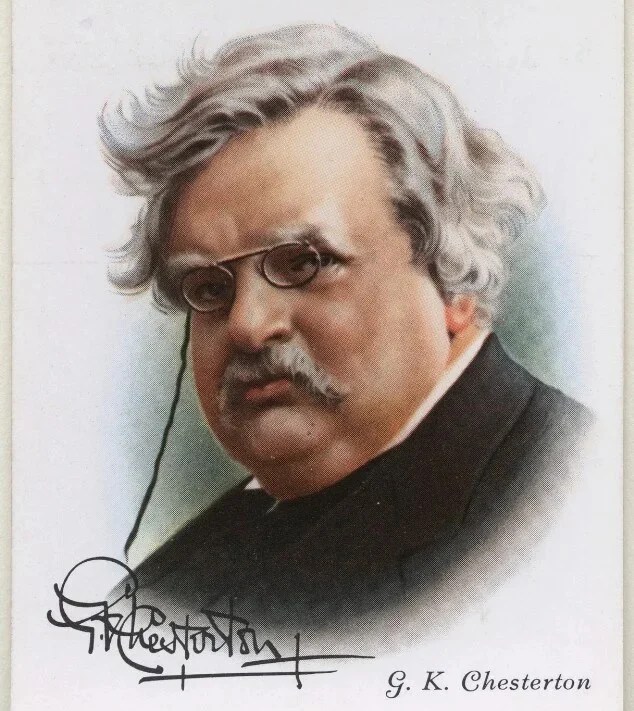
It must be disclosed that I don’t really find G.K. Chesterton’s Father Brown Stories all that great. (Why is it that I so frequently write about things, people, and situations I truly dislike? I wonder what a trained psychiatrist would say about it?) As far as the mystery writing goes, I find them… unnatural, too artificially constructed, almost illogical… For everyone, of course, but the author and his deducing reverend. But naturally, they don’t count, because they are cheats, holding all the cards and the red herrings up their sleeves.

Moreover, I consider G.K. Chesterton a racist, which makes him absolutely unacceptable to me as an individual. Some of his descriptions and the choices of words simply appalled me back when I read him.

(If you feel tempted to verify yourselves that my accusations can actually be substantiated, read God of Gongs. That’s why I’m sharing the link to The Complete Father Brown Stories below. [And no, I’m not an Amazon Associate – it’s purely for your convenience.])

It is hard for me to imagine that any truly unprejudiced and open-minded thinker would be using such language, regardless of his/her native historical period and commonly accepted jargon of the correspondent time. And no, he is not just putting those offensive words into his characters’ mouths for the sake of the conversational authenticity. He uses them as his own narrative descriptives. It’s despicable and utterly inexcusable as far as I’m concerned.

But! One can find a grain of wisdom even in a truckload of manure. And this one goes straight to the heart of the main conflict suffered daily specifically by the American workers in employment of the entrepreneurial business owners – the same antagonism that cemented the foundation of my own madness (“I Built This Prison”):