I Built This Prison: Teaser #3: I Just Hate Job Hunting


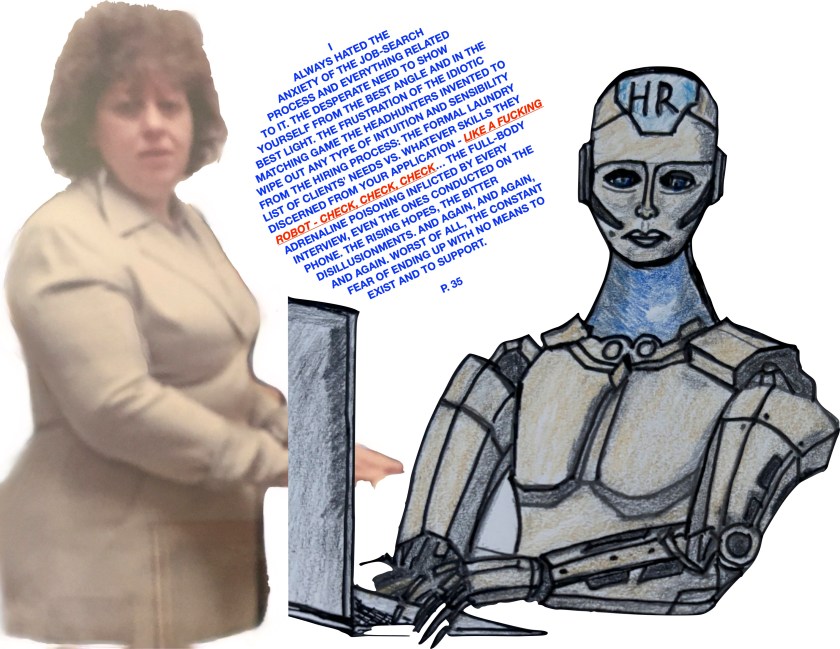
I always hated the anxiety of the job-search process and everything related to it. The desperate need to show yourself from the best angle and in the best light. The frustration of the idiotic matching game the headhunters invented to wipe out any type of intuition and sensibility from the hiring process: the formal laundry list of clients’ needs vs. whatever skills they discerned from your application – like a fucking robot – check, check, check… The full-body adrenaline poisoning inflicted by every interview, even the ones conducted on the phone. The rising hopes, the bitter disillusionments. And again, and again, and again. Worst of all, the constant fear of ending up with no means to exist and to support.

  I Built This Prison, p. 35

Quote of The Week: Cassandra’s Curse


Quoted directly (as written) from the actual email sent today to the frustrated CFO by her CEO:

“Marina,

You are so right about the economy.  More than a half of the candidates I talked with today are looking for a job because they were laid off as the result of their companies’ downsizing or being swallowed during hostile mergers.  One of the candidates worked for the same company for 20 years, and she is now looking for an entry-level job just to get stable employment with benefits.  Amazing!  Most people don’t even know what’s going on with the economy, because they listen to lies.

LF”    

The Struggle Is Real for Employers As Millennials Enter the Workforce with Their Own Value System


Like many hiring execs, I still have an employer account with Monster.com, even though the time when they dominated the job-hunting market has passed.  Nowadays, they are not even at the top of the industry leaders list.  Still, we got used to them in the 17 years they've been around.  And they do try their best to provide the paying clients with value-added bells and whistles beyond the standard ad posting:  resume matching, database searching, description writing, HR Resource Center, and whatnot.  

Pouty ShirleyOne of these add-ons is the email service that blasts recruitment articles to all registered users.  I usually ignore these emails, but the last one had an article with an enticing title The Real Reason Millennials are Leaving Your Company.  

The first thing that caught my eye was the singular "Reason."  I thought, "The author was able to identify a single, most fundamental cause of what appears to be a case of chronic pins and needles in the millennial butts?  That's remarkable!"

I got even more curious reading the logline.  It talked about an abundance of options, "a plethora of jobs" that allow millennials to be "super selective" in their career choices.  Moreover, it promised expert advice to employers on how to keep the "valuable millennials" in the work seats.  I was like: This must be one of those sci-fi imagine-if humorous thingies, because these statements, if not drenched in undiluted sarcasm, can only refer to some remote planet in an unknown universe.  Here on Earth, right now, most of the millennials you and I know are either unemployed, or work jobs that have nothing to do with their chosen professions (let alone vocations), or stretch their schooling to avoid facing the bleakness of the job market.  I mean, there are premium cable shows and broadcast sitcoms about it.   

And, "valuable millennials?"  Yes, they exist, in small numbers and tiny clusters, and you ought to be very lucky to have them around.  But generally speaking: the state of our arts and entertainment is a testimony of young people's value and their values.  And when it comes to hiring, you need to go through 800 entry-level resumes to find 3 candidates who can write a coherent sentence, even though (I'm talking to you, senator Sanders!), all of the applicants have college degrees.     

Opening the article immediately dispelled all enthusiasm.  Firstly, no pinnacle reasoning was crystallized.  The piece was divided into subsections addressing different causes for millennials' job mobility.  Since the author is not a Canadian afflicted by the national inability to pluralize words, I can only attribute the use of the single form in the title to writing and editing sloppiness.  And, of course, there was not a single whiff of alien or any other humor.

In fact, the self-branded Talent Maximizer® Roberta Matuson, who wrote the article, takes herself and her "advisory" role very seriously.  In complete solemnity she lists the following as the reasons why the millennials don't want to hold on to their jobs (with my commentaries):

  • Millennials want to work for companies that help to improve society.  Ms. Matuson suggests that those employers who want to retain Millennial workers should "take a closer look at the organizational purpose," assess how the company's mission impacts society, and redefine its purpose.

To paraphrase Woody Allen, "What's wrong with this?  Everything!" 

First of all, what does the lame formula "improved society" mean?  What's a "better society" for one person, is hell for another.  The massive support of Bernie Sanders by young voters clearly shows that they want to live in a welfare state.  I, on the other hand, have been preaching no government interference and market economy my whole life.  I would understand if the focus was more specific – let's say on environmental issues.  If employees of different ages boycotted the fracking industry, for example, our society would seriously benefit in the long run.  But I doubt we are talking about future impact here.  I'm pretty sure that if the fracking industry started providing free daily lunches to local people, the millennials would think of them as employers with a positive mission!  Never mind the explosions and the fiery faucets.

And what happened to the old-fashioned purpose of being profitable, staying in business, and continuously providing jobs?  It's not good enough?  Do all millennials want to work for non-profits spending grants, or public companies depleting investors' pension and college funds?

  • Millennials need constant external motivation: nurture, praise, repeat.  A shout-out here, a lunch with a boss there, or an invite to an off-site event, Ms. Matuson suggests, will help to demonstrate that the employers care.  Otherwise, the millennials will leave, because "the recession is over."  

Well, this is not the first time I am confronted with the suggestion that what I call "hugging motivation" is more important to younger people than fairness, objectivity, professional growth, adequate compensation, etc.  Don't get me wrong, the acknowledgement of one's achievement is incredibly important, but only if it's deserved.   Constantly patting on the back some unimpressive, low-value jackass out of fear that they will leave – that would be a betrayal of my work ethics and a violation of my fiduciary duty as a CFO.  Merit-based rewards, people!  That's what made America great in the first place and that's what will bring the greatness back! 

And here she goes again with the sci-fi twist: the recession is over!  Where?  In Alpha Centauri?  Oh, wait – on the front page of The Wall Street Journal and in government reports.   In real life, we are in the permanently recessive stage of economic decline with no prospects for upward turn.  This slow sliding may feel to the uninitiated as a flat plateau, but just you wait - we are bound to experience some dramatic crashes as well.

  • (Brace yourself for this one, cause contrary to the previous statement:) Compensation is important to millennials, especially if they have student loans.  "If you don't pay the millennial whatever he or she thinks they are worth," they will leave.

So, no matter how much you praise them, and hug them, and take them to lunch, the old-school paycheck still matters! Except there is nothing old-school about it either.  Back in the day, wages were determined by clear and tangible factors: the sophistication of the job, the level of expertise, the scarcity of QUALIFIED professionals on the market.  But apparently it doesn't work like that with the generation of people who were born after The Breakfast Club and Back to the Future came out.  The key to their adequate compensation is their own self-worth.  We must pay them whatever they think we must pay them.  And don't forget, the employers need to account for the student loans!  Essentially the implication is that we have to pay them what they NEED and not what they earn.  "From each according to his ability, to each according to his needs" maybe sounds right to Sanders's supporters, but it is not the principle that lies in the American foundation.  You know whose principle that is?  Marxists-communists!

  • Millennials require work-life balance.  

Just the millennials?  Is that what the article's author actually believes?  That millennials should be treated preferentially when it comes to working hours, paid time-off, etc.?  That there should be two different HR policies in every company, one for millennials and another for the rest of us chickens?  That's age-based discrimination, isn't it?   

I've always believed in the importance of work-life balance and regularly wrestle with the owners to ensure that every employee has access to the same set of benefits and perks.  And what my experience shows is that the millennials take the full advantage of these packages like no one else; sometimes to the point of abuse.  90% run out of the office the minute the clock strikes the official end time, no matter what's happening with the work.  Many don't even spare a few seconds to shut down their computers (yet all of them fancy themselves "environmentalists").  Just last year, I had a millennial employee who was out for 15 working days in the 5 months I tolerated her bullshit.  I've never had to deal with that kind of attitude before the millennials entered the workforce.         

The truth is that you don't need to be an HR expert to formulate your ideas about the reasons behind the millennials' prevalent job discontent.  Any experienced manager with a keen eye and some human insight can draw up a comprehensive list.  And here is mine (in no particular order):

  1.  Many millennials, especially liberal arts majors, have a hard time defining their purpose and developing a sense of belonging at a job.  This is primarily because they go to college to learn… nothing.  I'm not even talking about slacking and partying.  There are so many narrow-niche bullshit "liberal arts" degrees out there, most bachelor graduates acquire no practical knowledge.  And it makes thinking of a career path very difficult.
  2. Much scarier, they are not equipped with any basic learning skills.  They can neither study on their own, nor operate with minimal supervision.  Not able to absorb new knowledge, they feel like failures and will eventually leave for an "easier" job.
  3. Turns out that the damned phone is a millennial Achilles heel.  The millennials are so used to texting, tweeting, and posting, 85% of them are afraid of talking on the phone.  When confronted with a job that entails constant voice-to-voice interactions, which are a plenty,  they opt to quit.
  4. Aside from athletes and health freaks, young people nowadays live incredibly passive lives.  Some people say that the abundance of streaming content is to blame, but we all know that way before YouTube (2005) and  Netflix's streaming (2008), young people were already glued to their computers and game consoles.  Thus, they suffer terribly on the jobs that require them to be out of the office most of the time – selling, pitching, servicing, etc.  According to some HR professionals, this is one of the millennials' biggest complains.    
  5. The bulk of this generation grew up with no discipline or structure, both at home and at school.  While being a non-conformist is an invaluable quality when it comes to independent thinking and artistic expression, in a survival-driven business environment the lack of self-control, inability to follow rules of conduct, and disregard for subordination can make one's life pretty unbearable. 
  6. They want to be hugged and cuddled all the time.  Many of them crumble under pressure and cannot deal with reprimands.
  7. I know it sounds like a cliche at this point, but it is true – they do want trophies just for showing up, because that's what they are used to.  As a result, they develop a clinical deficiency of self-motivation for achieving merit-based recognition.  They shy away from competitive environments where hard work and achievement translates into tangible rewards of raises, bonuses, and promotions.
  8. Celebrity-saturated social media made the majority of millennials into unsettled zombies who are preoccupied with fantasies of becoming instantaneously rich and famous.  I guarantee that the star-struck ones will continue moving from one job to another, feeling extremely discontent.   
  9. The majority of the millennials are not prepared to be self-reliant.  The livelihood of many a chronic quitter usually doesn't depend on their own paychecks; they expect to be continuously supported by their parents.  
  10. And some young people, just like in every generation before them, are restless because they want to be adventurers; they are afraid that Life will pass them by.  The boring job can wait; while they pursue their dreams.  And, of course, sadly, most of them are confused, and don't know what they want, and don't have any ideas, or talents, or clues.  But let me tell you: that is the only good reason to quit your job (assuming you can afford it).  All the others are just weaknesses and incompetence.           


Photo Quote of the Week: The Millennial Conundrum


© 2016 Original by YAC. All rights reserved.

10 HR Lessons From Summer-Binging on “The Good Wife” Plus Some Other Stuff


The Good WifeIn the TV business, summer traditionally has been considered an off-season.  Primarily because the broadcast networks' prime series go on a 4-month hiatus after completing their 20+ episode seasons.  Nowadays, of course, it's not all that relevant for TV viewers, because…  Well, for multiple reasons, really, but to name a few:  

First of all, if you prefer edgier premium cable series, your TV viewing patterns are driven by  2-3 month seasons scheduled at different times throughout the year: Shameless airs January through March, Game of Thrones and Silicon Valley - April -June, Masters of Sex – July-September, Homeland –  October-December, etc.  Even if you are into blending your TV cocktail out of cable and broadcast ingredients, you most likely use on-demand and DVR options to accommodate your personal schedules and to fill the airing gaps.  Plus, some broadcast networks now have "summer shows" – short-seasoned and "limited" series aired specifically to cover the off-season void: Hannibal, Wayward Pines, Under the Dome, Aquarius, etc.

The most important factor, however, is that we've stopped being restricted by conventional TV ever since Netflix came along.  First, they made the idea of going to video stores and looking for something to watch unnecessary.  We were so grateful for digital searching, online ordering, and USPS drop-ins and drop-offs.  But then even walking to the mailbox became unnecessary, because they made a tremendous volume of content available for IP streaming, including rare and obscure movies, shows, documentaries, anime, etc. from all over the world! 

They didn't stop there either - they got into creating their own original programming.  And then Amazon followed suit!  As a result, we got access to gems that make me feel as if I am living through some sort of an indie renaissance via the Internet: House of Cards, Orange Is the New Black, Peaky Blinders, Grace and Frankie, Sense8 (Netflix originals), Transparent and Mozart in the Jungle (Amazon's originals).  It's fucking incredible!

Moreover, not only that streaming content is available everywhere you can go online, it's available in whole seasons.  There is no waiting for weeks at a time until the next episode; no mid-season separation anxiety; no loss of vital details from previous weeks.  Technically you can watch a 12-episode season in one day.  It is my understanding that some people actually do that. 

Netflix had at their hands the best market-testing sample imaginable – their entire subscription base.  They must've noticed early on that a large percentage of the viewing population doesn't restrict itself to one episode at a time.  They even installed a special probe at the start of the third consecutively watched episode to test whether you are actually binging or have simply fallen asleep on your couch.  Brilliant! 

Yes, binging – as in excessive indulgence, as in manifestation of addictive personality traits.  Not a new thing, really.  TV networks (USA especially) have been scheduling rebroadcasting marathons since the 80s.  By offering this opportunity to audiences with pretty much any kind of preferences, Netflix forever altered the cultural lives of millions of people. 

The phenomenon itself became a marketing tool for Netflix's competitors, who want you to know that you can replicate this experience with them as well:  This summer, Amazon actually used the phrase "binge on your favorite shows for free" in its promotional messages for Premium subscriptions.  HBO, still holding onto their highbrow status, softens it by offering you to "feast" on your past and present favorite shows on HBO GO.

Poor David Foster Wallace warned, way before streaming had become a household concept, that Television is the one and only true American addiction.  He predicted that catering to user demand for content of their choice whenever and wherever they wanted it (remember the "direct dissemination"?) may irrevocably alter us and potentially result in the crumbling of human will.

But who am I to judge?  Yes, my life is too busy for hardcore binging and I refuse to watch an episode of anything on my goddamned iPhone, but I've been taking advantage of on-demand entertainment ever since it was first introduced by American cable providers 15 years ago.  Then came iTunes 6.0 (2005).  Today – Netflix, Amazon Prime, Hulu Plus, HBO Go, Showtime Anytime – I've got them all, including a Fire Stick to carry them with me wherever I go. 

But that was not the topic of this post, was it? (Too bad you cannot hear me laughing at myself.)  This was meant to be a brief introduction to the shocking fact that, even with all that variety of quality entertainment on hand, at some point in July I found myself with my personal TV time-slot empty.  And let me tell you, that made it hard to ignore the binging and feasting callings of the content pushers.

I browsed the variety of offerings and ended up with The Good Wife on Amazon Prime.  It used to be one of the shows I watched during its active seasons – all the way through the middle of Season 4.  But then, 2013 announced its arrival to Netflix with their first two major originals, plus Top of the Lake, plus The Fall, the first season of Broadchurch, etc., etc.  I'm a busy woman – something had to go.  Now I picked up where I left off.  

I have to admit, assuming you manage not to paralyze your life or degrade your mental and motoric agility, watching multi-season, multi-episode shows without gaps measured in weeks and months has its undeniable benefits.  Complex and intricate storytelling loses some of its power when it's broken up into weekly installments and then gets shelved away for 4 or more months.  Reducing these gaps not only allows for a more detail-oriented viewing, it also gives you an opportunity to assess the show's merits and values in a more coherent way. 

Aside from the most obvious and well acknowledged attributes of The Good Wife - strive for realism; acute attention to the impact of technology on our lives; honest depiction of shifting morality; head-on tackling of race, class, gender, sex, and all other divides - what I like the most about the show is its refusal to label itself as a single genre.  We can definitely identify it as a Drama, but the range of applicable modifiers is quite long – family, political, crime, legal, courtroom.

But what I realized while watching seasons 4 through 6 now, was that in it's wardrobe full of genres, The Good Wife's favorite outfit was the Workplace Drama.  One law firm, another law firm, State's Attorney's office, governor's office, clients' businesses (including a drug-distribution organization), you name it - all of them are depicted as places of employment.  And the human relationships inside these businesses play essential roles in the show's storytelling.  The office politics, alliances, squabbles, hiring, firing, promotion, compensation, peers' competition, subordination, fraternizing, partnerships, resignations, harassment, even telecommuting -  all of them have been used as plot points.

Once I started noticing, I've found so many typical and easily recognizable Human Resources issues,  it was hard to pick the following ten:

  1. Any employee, no matter how highly positioned and compensated, is always a disgruntled employee.  It's remarkable how much pent-up gall towards Lockhart & Gardner started spilling out of Alicia and Cary as soon as they left to set up their own firm.  They were never that rude to any other opponents as they were to their former bosses.  What was it that Cary said to Will and Diane? That watching them squirm gives him an immense pleasure?  It's the nature of a subservient position – no matter what, we don't like it.
  2. Why don't we like it?  Because there is no such a thing as a fair boss. Every boss believes that you belong to him, yet he doesn't really need you and will do just fine without you.  That's why bosses never bother acknowledging, even to themselves, your full contribution and think that you should be grateful for what you've got.  Aside from always high-in-demand Kalinda, all other major and minor characters have experienced that.
  3. Recruitment is the most depressing of all managerial responsibilities.  Will and Diane need to hire more attorneys.  They sit down with their headhunter to look at the resumes she already preselected for them.  Barely glancing at them, Will goes, "No, no, no…"  And let me tell you, whether you are an asshole or a saint, this is what you do.  And I know that not everyone sees a life story behind every resume, still it's an incredibly unpleasant exercise for all.
  4. An easy interview is rarely a successful one.  Will is interviewed by Geneva Pine and her colleagues in his bid for an outsourcing contract with the State Attorney's office.  It goes great – quick and short; no follow-up questions, no drilling into specifics.  Why? Because it's just a formality – Lockhart & Gardner were never even seriously considered. Whether you are pitching yourself for employment or your company's services for a contract, the interviewing principles are exactly the same.  A short, formal, and overly polite interview means that you are not getting the job.
  5. Only full-time employment comes with benefits coverage.  This one is important because many people are still confused.  Kalinda, who has been working for Will for years, is appalled that newly hired Robin has medical coverage.  Except Kalinda cannot possibly qualify for benefits because she is a 1099 contractor with other billable businesses.  This allows her not only to delay paying social security taxes, but also makes a lot of her expenses tax deductible.  In order to receive company benefits one must be a full-time payroll employee with a minimum of a 30-hour workweek.  You cannot have it both ways.
  6. All computing and communication devices provided by employers belong to the said employers.  I know that many viewers may feel dismayed when they hear various bosses on the show proposing to hack into their employees' emails.  The truth is, however, that the employers are absolutely within their rights.  All devices paid for by the employer and everything inside of them are the company's property.  Not only is it implicit, but it is explicitly outlined in every single Employee's Handbook.  Yet, so many people treat the company's equipment as their own.  Hillary's personal email debacle is one recent memorable example.  People, don't be cheap and lazy, buy yourself a personal phone, external hard drives, and whatever else you need to keep your private contacts, communications, and files separately.
  7. The impervious pregnancy shield.  Governor Florrick's Ethics Czar Marilyn Garbanza is pregnant and the father is 76-year-old!  Can you trust a person like that with any type of government responsibility, let alone the one that requires clarity of reasoning?  Yet,  nobody reassigns her (of course, she cannot be fired – that's a lawsuit right there), because her condition blocks everyone's common sense.  In fact, her looks merited more suitability discussions than the fact that she made a decision to have a child with a septuagenarian.
  8. Workplace honesty is a relevant thing.  There is an information leak from Florrick/Agos.  Three key people (two lawyers and one investigator) privy to the information are being questioned.  All three deny any involvement.  Alicia says, "These are the most honest people I know."  Mind you, at different points in time we've seen these characters mislead their clients, lie to their opposition, trap witnesses, steal information and evidence, even betray one another!  Yet, that was all done in the "normal course of business;" to get the job done, i.e. to perform your professional duties.  Nowadays, nobody considers dishonesty on behalf of one's employer amoral.  I've done it and you've done it; everyone does it.  Are we absolved and untainted because we presume there is no direct personal gain?  That's the question.
  9. How do you know when someone in the office is sleeping with the boss? Look for the telling signs.  People cannot help themselves – they get emboldened by the perceived closeness to "power."  The person in question will stand too close, laugh too loud, dress inappropriately, pick fights with peers, become insufferable for subordinates and less diligent with their duties.
  10. One should always be aware of the temporary and unstable nature of any HR structure.  People die, get arrested on obscure charges, move on for higher salaries, or decide to be homemakers.  Companies go through mergers, buy-outs, and hostile takeovers.  And nobody, literally nobody, has a good life – everyone is fucked up and thoroughly unhappy, no matter how hard they try to hide it.  So, there is always a good chance that they may check out – out of job or out of life.  Or do something completely insane, like trying to shift from Law into politics.

But the most valuable life lesson one should take away from The Good Wife is that you should never ever burn all the bridges and cut all the ties, because you never know with whom you may need to partner next.