Further Scientific Evidence of the Entrepreneurial Bug


Over a month ago, in my post Your Boss: Value & Madness of an Entrepreneur I wrote about quirkiness and impatience of people who have brilliance to come up with original start-up ideas and guts to build a company from scratch – people who provide us, CFO's and Controllers, with new job opportunities beyond "Big Business." 

I also discussed how their peculiar and difficult qualities are the main source of our frustrations.  I called the sum of these character traits the Entrepreneurial Bug.

As if to support my point of view, September 18th issue of New York Times featured this article in their Business Day section – Just Manic Enough: Seeking Perfect Entrepreneurs by David Segal.  I highly recommend that everyone interested in the subject of entrepreneurship, start-ups and venture capital investment should read it. 

Of course, my own primary interest was the excursion into psychology of the indicators so characteristic of our bosses difficult behavior.  Needless to say, the article confirms that not every subject is afflicted with the entire spectrum of symptoms and displays them with the same intensity.  Nevertheless, the author clearly states that only "a thin line separates" an entrepreneur from a psychiatric candidate with a hypomanic syndrome.

One of the article's subjects, Seth Priebatsch, echoes my post from 08/19/2010, when he "describes anything that distracts him… even for minutes, as 'evil.'"  No surprise here – I've heard this before many-many times from various CEO's.  The difficulties of working with people like that on daily basis, especially for CFO's and Controllers, whose job is to keep businesses in order and under control, is basically one of the main themes of this blog.

Mr. Segal goes out of his way explaining that the degree of craziness is what matters: some Venture Capital firms give personality tests to their prospects in order to determine if they are not completely bonkers.  But I couldn't help myself thinking that these tests may be also designed to weed out people who are not crazy enough to be satisfactory material for future transition from idea generators into screw tighteners.

Strangely enough, the New York Times' confirmation that my extrapolation of personal experience dealing with business owners to the rest of the entrepreneurial world is completely justified, did not bring any intellectual satisfaction.  It's kind of discouraging that if you choose to build your career in dynamic growing businesses, you will always have to deal with bosses who cannot help themselves not to be assholes.  
New Job Hunting Secrets for CFOs and Controllers


All CFOs, Controllers, VP Finance and Financial Directors, especially in small businesses, are involved in recruiting process.  Most of them don't have in-house recruiters and nowadays not too many businesses can afford $25,000-$30,000 headhunters fees.  So, with hiring on one side and testing the market (or in the current economy actively looking) for themselves on the other (plus payroll, benefits, etc. management), their involvement with HR is pretty significant.

However, because they don't work for businesses with thousands of employees and are not professional recruiters, small and mid-size financial execs are not necessarily up to date on the talent-searching technology.  While going through hiring process they are still printing resumes, looking through them manually … – you know the process.  And when the tables turn around and some of these execs are forced to search for new employment themselves, they expect their resumes to receive the same treatment even if they apply for a job in a larger company with its own in-house HR department or reply to a recruitment agency's (such as Robert Half, Michael Page, Source Associates, Forum Group, etc.) ad. 

How could they possibly know, especially if they have been off the market themselves for several years, that today large HR department and recruitment agencies work with automated Applicant Tracking Systems (ATS) – software that in its sophistication goes beyond database matching and usually employs cutting edge data-warehousing technologies?

 I know plenty of financial execs who are so proud (rightfully so) of their accomplishments they don't even bother adapting their resumes to the nuances of advertised job requirements and keep sending them out "as is" regardless of the recipients specifications.

Please, do yourself a favor and read this recent article from TheLadders  The 24-Step Modern Resume.  Not only it is incredibly valuable on its own (an eye-opener for uninitiated, really), but in the text you will find links leading to further details and related subjects. 

I also highly recommend The HR Capitalist blog.  It will provide members of financial executive talent brigade with an opportunity to learn what the other side – the hiring professionals – think.  I found particularly fascinating the insights into Social Recruiting and the important place it occupies in today's hiring in Why Social Recruiting Isn't About Having a Corporate Twitter Account


First Impression Is the Most Lasting Indeed


They say that the first impression is the most lasting one.  And it is true even for those people who try very  hard to be fair and give people a chance to show their true qualities. 

I myself is one of those people who make themselves look past the appearance of a job applicant.  Few years ago I have interviewed a woman who was grossly obese and needed a cane to assist her in moving her body.  I knew right away that aside from possible health issues, there could be multitude of other problems: we would need to order her a special X-large chair, my CEO may not like someone like that to be prominently installed in the Operations Department, visiting business relations may be destructed by the sight, etc. etc. 

Nevertheless, I gave her a full interview, which she passed with flying colors, and ended up hiring her.  It never even occurred to me not to offer her the salary attached to the position.  She got paid the same wages anyone in her place would.

Turns out, I am a rare exception.  Please, read this post from Vault's Career Blog Does your weight determine your salary?  The statistical data reported in the article are appalling.

Weight issue aside, my opinion is that when it comes to hiring process the entire "first impression" concept is very unprofessional.  Time after time, hiring execs, recruiters and variety of HR professionals yield to their contrived, closed-minded, self-centered views of other people instead of thinking of what's best for their companies.

Two weeks ago my good friend MJZ, also a career CFO, went for a job interview to a company that provides services to children with learning disabilities and autism under the contracts with various government health agencies.  Since such programs usually become first victims of states and counties budget cuts, the company desperately needs someone who can strategize their way into more diversified revenue models.   MJZ has a vast experience of building such strategies and facilitating companies' growth. 

She has previously had a phone interview and communications with the CEO's personal assistant.  So when in-person interview invitation was received, she assumed it would be with the CEO herself.  However, she was interviewed by a middle-rank HR Manager.  

When she told me that she did not even make it to the next round – the actual interview with the CEO (the HR Manager sent her an email), I've asked for the entire meeting description.  Now, knowing all details, I am confident that the HR Manager's rejection had nothing to do with MJZ's professional qualifications.  It had to do with the fact that she was dressed for an interview with the CEO and instead was assessed by a sweater-and-tights-clad middle-manager. 

The sad result is that the company had missed an opportunity to hire somebody who could have brought them to the next level of development.  Their loss, of course, but nevertheless a disappointing experience for my friend.

The Frustrated CFO Is Getting Anxious


I am really anxious to move away from abstract discussions on the nature of stress we experience every day and start showcasing stressful incidents and frustrating professional issues near and dear to every CFO, Controller, etc.  However, before I do that I feel we need to address one more theoretical subject – correlation of Frustration and Anxiety.

As I already mentioned several times, frustration is a normal reaction (whether extra- on introverted) to situations in which we face obstacles to our achieving goals or actions that contradict our standards, etc.  Every person experiences it from the moment he or she is born.  In this blog, with examples from daily war of survival, I argue that my peers, CFOs, Controllers, and other financial execs in entrepreneurial environment, operate in a state of chronic frustration.

Anxiety, on the other hand, no matter how many scientific definitions are out there, boils down to sense and fear of danger, whether real or non-existent.  The symptoms and sensations are the same if you are genetically predisposed ("wired") for anxiety or forced into it through the lifetime of conditioning.

Because it is far more fascinating to try to explain why some people feel anxiety and panic attacks for no tangible reasons at all, cognitive science is primarily preoccupied with the types of anxiety that are caused by chemical imbalance, hereditary factors, etc.  If you are interested to learn more about the latest research advancement in this area, I particularly recommend an almost a year old, but still very accurate and exhaustive, New York Times Magazine article Understanding the Anxious Mind

And, of course, most of us belong to the army of Americans (tens of millions of people, actually) who are worried about the economy, their job security, the money they lost in various market shakeups, the environment, the future of their children, etc. etc. Economic and environmental issues are big reasons why so many people seem to be on the verge of a breakdown.

That said, in the context of this blog I am primarily interested in the undeniable fact that chronic frustration with your job leads to stress and acute anxiety.  Just like Pavlov's dogs we are conditioned by frustration to fear those situations that cause the unpleasant experience.

We try to accomplish a particular task, meet our regular obstacles (bosses interventions, subordinates incompetence, time constraints), fail to achieve our goal, get frustrated – and (surprise-surprise), now we feel anxious every time we start that task, because subconsciously we anticipate frustration and fear the pain.  The anxieties accumulate into stress, and now we feel trapped.  If the situation is not managed, we can spin out of control.

And that is why it is so important to find methods of releasing frustration out of your system (please see my post One CFO's Personal Tools for Frustration Relief) and, just equally important, find resolutions for your professional problems by elevating your managerial, organizational, behavioral and technical skills – issues I hope to discuss in the future based on the incidents from your professional life.  

The Dashboards Obsession


It is easy to understand how executive dashboards have become so chic.  Most products come to mass market by way of technological advancements.  The 3-D movies fascinated audiences in select theaters for decades.  Now, we have 3-D TVs in our homes.  By the same token, specialized and complicated business intelligence software (like Cognos) existed since the 70s.  However, the 21st century brought forward adaptable, customizable, open-architecture systems and integratable reporting tools. 

Business intelligence and financial performance management are not new ideas.  Data warehousing may sound like a novelty, but collecting and organizing records in a particular order for easier access existed for centuries. The concept of information as a key to business success is millennia old.  How many spearheads you are going to make, if you don’t know all the warriors in your tribe? 

Of course, nowadays data flows are more complex.   The CFO’s and CEO’s need information integrated from different sources and they need it fast.   So, the developers caught up with the demand and offered executive information systems aka dashboards.  They advertise, give distribution licenses to specialized vendors, hold conferences, etc. As usual, standardization is mandatory in order to capture larger market shares, and that’s where the fallacy forms. 

Don’t get me wrong, they are beautiful visual arrangements – much more vivid than dry columns of numbers, far more impressive and memorable.  On top of that, more expensive ones allow you to drill down into the data behind them.  That’s incredibly cool!

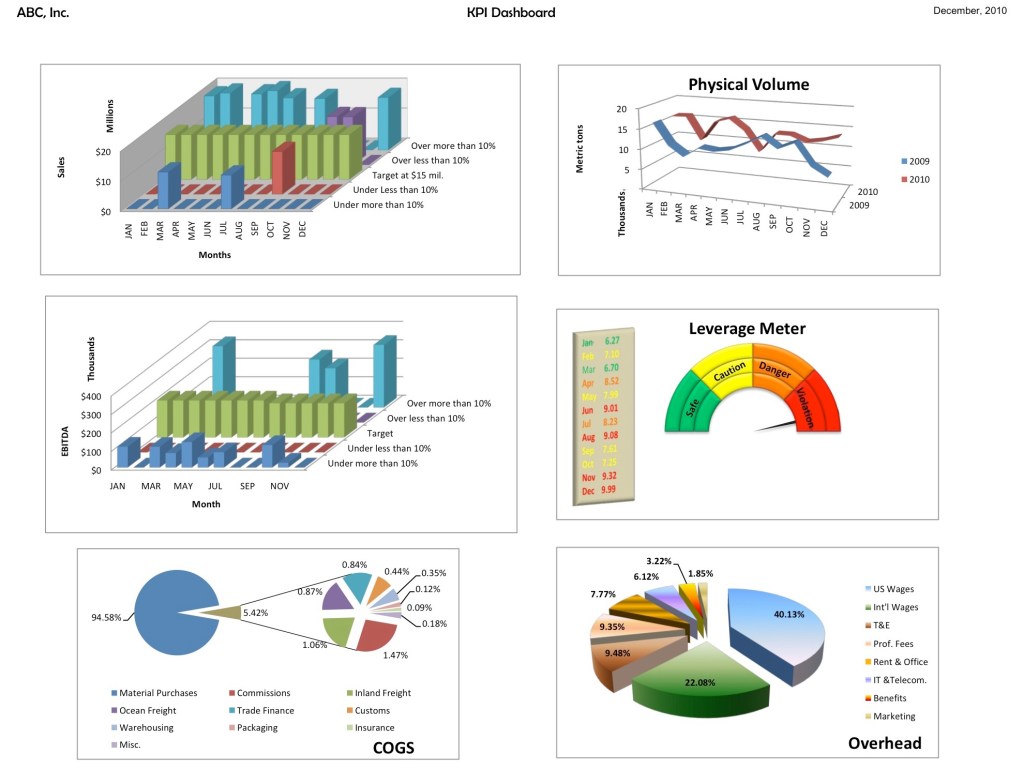
Here are some of mine own:

Yet, in far too many instances the form obscures the substance.  Now, the users think they need something looking exactly like that, instead of thinking what info is fed into it.  And it is very sad, because CEOs and CFOs in need of sensible information, frequently end up just looking at a pretty picture.

I’ve seen a lot of dashboards – most of the time I find them absolutely irrelevant.   You are looking at your 12-month revenue curve and it displays expected cyclical pattern.  What are you learning here after spending a tidy sum for ability to generate this graph with a push of a button?  Nothing new – your last year curve had exactly the same shape.  How do you know whether you are doing better or worth now than a year ago?

And the gauges!!!  They look awesome and they justify the name “dashboard,” but they are the most difficult charts to read.  Moreover, they are kind of useless for static information.  Unless a constantly changing (and most importantly, crucial) information is fed into this device in real time, you have no reason to stare at a red circle with green border and unmoving black arrow.    

Here is my advice: don’t fall for colorful pictures.  Start from the beginning.  You know which information is most important for you and your CEO, which parameters affect your business’s ability to survive.  Figure out what combination of data would make the real impact on your decision-making, how frequently you want see it, whether it needs to be dynamic or static, etc, etc.  Only after that you can think about the format. 

Let’s say your product’s price is in direct correlation with crude oil market.   In this case, may be the two sets of data should be presented together, or maybe it’s most important to look at the units, not the sales dollar value?  Those are the important decisions, not the shapes and colors.

It is very possible that you need bar charts, graphs, even gauges.  Hey, if you are a jewelry manufacturer and make raw material procurement decisions all day long, there is nothing wrong with having a gold price meter installed right in the center of your screen.  At the end of the day, it is all about common sense.