How Far Can They Push Us?


The post about infringement of freedom in the workplace generated further discussions among my peers. 

Some people actually said that I made them very depressed by putting into words realizations they try to avoid.  I would like to remind these people that the Welcome page of this blog, Reason to Share, clearly expresses my belief that sharing frustration gives us therapeutic relief.

Others felt that my "uplifting" statement that one can always quit was clouded by the suggestion that most CFOs and Controllers cannot afford to do so.  Indeed, I keep talking about how difficult it is to find a CFO/Controller level job nowadays.  That's why I don't suggest quitting without lining something else up or having sufficient funds to keep yourself afloat during the job search.  The truth is, you need to establish an emergency fund anyway – as I always say, there is no such thing as job security for anyone in this new world.

But let me tell you from my own experience, there comes the time when you just know you cannot deal anymore.  You are so frustrated, anxious, depressed, angry and hopeless, you cannot breath.  No matter what you do to get a grip, it feels like your balance is slipping away.  If that's the case, it is time to make your move, because otherwise the suffering is going to destroy you either psychologically, or physically, or both.

I have many stories about people pushed too far and, hopefully, I will be able to tell them here at one or another point.  However, for this particular post I decided to use, as means of a more familiar illustration, a Hollywood classic by Billy Wilder – "The Apartment" (1960). 

The main character (forever great Jack Lemmon) is not a CFO or a Controller, but he is an ambitious person and the gist of the story is very relatable to subordinate employees on all levels.  You see, he really wants to climb the career ladder.  So, he lets the VPs to use his apartment for their extramarital encounters.  He even lays out snacks and liquor for them to enjoy. 

When he allows himself to be convinced by his boss to leave his apartment on  a rainy Christmas Eve, he is angry and frustrated, but he keeps his mouth shut.  And finally he gets that "big promotion" he'd wanted.


Jack's character falls in love with the elevator girl.  He doesn't know that she has been to his apartment with one of his bosses as well.  When the moment of truth finally comes, he feels so overwhelmed, he realizes that he cannot be a doormat anymore.  The time has come to be a human being.


So, gives up his job.  Of course, as in all Hollywood fairy tales, he gets the girl (an adorable Shirley MacLaine) as a reward for his courage.  But it does not matter: rewards or not, everyone has their own threshold of pain tolerance.


Why Are Ex-Bosses Mad at Us?


Daruma People complain to me about not being able to get in touch with their old bosses.  This means they are talking about business owners. 

I have not heard of anybody having problems like that with their former supervisors from large companies.  After all, those people are subordinates of their own bosses too.  Unless you have spat into his coffee mug or slept with his wife, the two of you should still be on good terms.

It's a different story with Owners/CEOs.  Some may ask, why do you want to be in touch with them?  As the matter of fact, for many reasons.  I've already addressed the references issue (see my post from a month ago CFO's References Trap).  He (I am talking about an archetypal boss now) may have a networking connection you crave.  He may know someone you need to contact for your new business.  You liked his attorney and now you need one.

There could be a million reasons.  But you cannot reach him.  You emailed, you left messages with his assistant and/or wife, you tried to contact him via mutual relation…  No response!  And that fucking hurts! 

You have toiled 60-hours a week for him, you grew his business, you made him richer, you saved his ass from troubles numerous times.  Hey, you pulled him from the verge of bankruptcy and complete destruction!  Hell, it's his fault you are not his CFO/Controller anymore.  You are the one who should be mad at him!

And the funny things is – other people who worked there adore you.  They tell you how great and important you were to the entire company, how much they've learned from you.  Yet, the person who benefited the most from it, doesn't even want to acknowledge your existence.

Now, let's put emotions aside and think about it with our cool, rational financial minds.  There are obvious reasons for your ex-boss to be mad at you:

1.  You warned him about troubles that may befall his business and did your best trying to cover the risks, but he didn't listen to you.  Now, history proved you right.  Do you really expect him to talk to you and acknowledge that?

2.  Even before your ways parted, subconsciously he knew your were the smarter one.  Secretly he hated you for that.

3.  In his mind he expects to hear, "I told you so."  He has no clue that your decency would never let you do that.

4.  If he contracted and managed to save the smaller version of his business, in his head he probably blames your absence for his inability to grow back. 

5.  He had to hire three people to replace you and still they cannot keep up.  Whose fault is that?  Yours.

6.  And that secretary of his…  Well, let's not go there.

If any of these scenarios apply to your case, I guarantee, he will never talk to you, even if he needs you desperately.  He is the BOSS – he cannot put the ego aside the way we always do.     

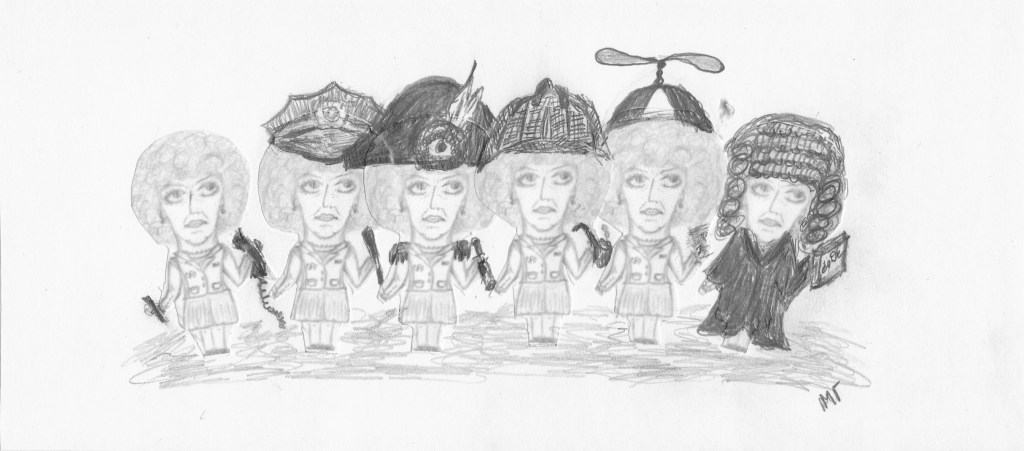
Illustration to the Recurring Subject of CFO’s Many Hats


These are just the transformations the small-business financial execs experience on daily basis: from CFO to Policy Enforcer to Strategist to Forensics Pro to Computer Geek to Legal Authority

If you are interested to read more on the subject, please, go back to my very first two-part post:

CFO’s Many Hats: Etiology of Affliction, Part I.

CFO’s Many Hats:Etiology of Affliction, Part II.

Readers who have stories to share, as always, welcomed to contact me.


CFO (or Controller) Puts on Her Recruitment Hat


It is difficult to look for a job – I already talked about it several times and even have a "Job Search" category to keep the related posts in one place.  Every time I encounter information that may help job-hunting CFOs and Controllers, I make sure that it finds its way into this blog.

But what about my peers and myself who are in an active headhunter mode?  Truth: we dislike looking for people nearly as much as job-searching.  I guess, being a seeker is not as enjoyable to us as it is to Harry Potter.  

Pitching yourself to prospective employers and recruiters is nerve-straining.  Dealing with unfairness, randomness and subjectivity is frustrating.  Facing rejection is disheartening.  That's all true.  However, after each attempt you collect yourself, you move on.  

On the other hand, recruiting people who will work for you, who will carry out functions you delegate to them, but for which you are ultimately responsible, is not just an excruciatingly difficult and tedious work.  When that stage is over, you are not done -  this is just the start.  Now you have to ease the new hire into his functions, fill him with missing knowledge, perfect his ability to perform the tasks, i.e. develop your new staff member into an asset. 

Here is what frequently happens.  After spending your preciously scarce time looking through hundreds of resumes, interviewing candidates by the score, all you want is to get this damned recruitment issue off your agenda.  If you cave in and make a mistake of hiring a wrong person simply because you are tired of the process,  you will still go through the remaining steps without a chance of achieving the desirable result.   So, all that time will be completely wasted.  Moreover, it is damaging to the company, to your own success, to your staff's morale.  It leads to enormous amounts of the worst type of frustration – the one that's based on guilt.

Why do we end up falling into this trap?  If you are not a giant corporation that can afford to fill departments with bodies and let the most ambitious and talented ones to surface, every person you hire needs to be the best you can find.  And of course, you are somewhat handicapped by the fact that you are not a household name. 

Still, it is shocking really how difficult it is to find good candidates considering how many people are out there unemployed.  On one hand, it is a buyer's market, on the other hand, the shelves are stocked with generic products who are limited, unfocused, and dull. 

And I am actually very flexible.  I don't hold industry-specific experience in much regard.  I believe that it depends on a person, and not the school,  whether he is well educated or not.  What I am looking for is that spark in the eyes showing intelligence; the ability of systematic thinking; the foundation I can build on.  And that's hard to come by.   

One CFO’s “Page of Frustration”


I thought I'd show you my own Page of Frustration.  However, I insist that if you decide to use this method of release,  you should create one for yourself according to the general description I provided in item 2 of my previous post One CFO's Personal Tools for Frustration Relief.  The process of designing your own Page will not only help you to work out the real reasons behind the frustration, but will also have a therapeutical effect.

  Page of Frustration-med