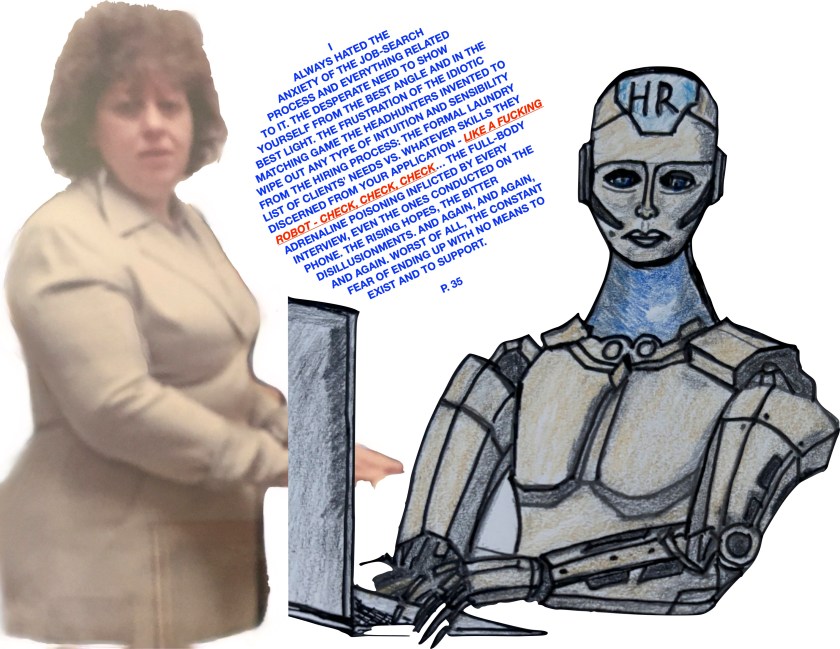
I Built This Prison: Teaser #3: I Just Hate Job Hunting


I always hated the anxiety of the job-search process and everything related to it. The desperate need to show yourself from the best angle and in the best light. The frustration of the idiotic matching game the headhunters invented to wipe out any type of intuition and sensibility from the hiring process: the formal laundry list of clients’ needs vs. whatever skills they discerned from your application – like a fucking robot – check, check, check… The full-body adrenaline poisoning inflicted by every interview, even the ones conducted on the phone. The rising hopes, the bitter disillusionments. And again, and again, and again. Worst of all, the constant fear of ending up with no means to exist and to support.

  I Built This Prison, p. 35

What Do Bosses Know About Their Employees?


1297457573478_ORIGINALWell, it varies from one boss to another, but one thing I can tell you for sure –nobody should ever expect a boss to bother learning who his subordinates are.  I mean as people. 

Yes, some overzealous HR pros in large companies paw through whatever material is made public by the social networking in pursuit of dirt, but  that's just "fact-finding" and gossip-mongering.  No, I am talking about a genuine human interest. 

In most cases there is none.  Watching all sorts of bosses interact with their employees I frequently wonder whether it registers in their heads that they deal with real people.  I think they subconsciously block this tiny detail out, so that they wouldn't feel guilty for being assholes.  So, how can you expect them to notice anything about your personality, if they see you as a cardboard cutout?  They are blind even to the most obvious manifestations of your existence outside of the workplace. 

You may belong to a weekend fight club and come to work every Monday with poorly covered bruises; or aspire to be the greatest drummer of all times and constantly bang your fingers on hard surfaces to some beats in your head; or know everything there is to know about existentialism and talk about it at length during office parties – none of it will be noticed: they see and hear it, but their minds reject it.  For them, you are still just Steve from Logistics, or Mike from Customer Service, or that girl from Accounting. 

Do I know for a fact that this sort of myopia exists?  Yes, I do.  My position as a financial executive and/or consultant allows me to observe various bosses in close proximity.  Over the years, I've collected a huge body of evidence to support my statements here.  But I can also vouch for their validity based on the incidents that involved me personally.  I'm not going to dwell here on the fact that none of my employers ever learned anything of my true motivations, ethical standards, or even why I work so hard and care so much.  Instead, let me share with you an instance of an inexplicable blindness.

I don't ever shove CFO Techniques into people's faces.  Being a book's author barely has any impact on consulting deals and it definitely has nothing to do with my CFO job.  But people do find out on their own: they connect with me on LinkedIn and see it on my profile, or they Google me, or whatever.  Normal people, not bosses.  A company's owner writes an email to one of his strategic financial partners with a copy to me: "Let me introduce our CFO M.G.  From now on, she is taking over all our M&A negotiations."  Apparently the fact that the three of us were at the same table during a corporate function has slipped his remembrance.  As per usual, I simply ignore it.  The external party doesn't:  "Not only that I've met Marina already, but I also keep her book on my desk."  The boss replies, "Oh yeah, I forgot, I introduced you, guys."  You may think that he deliberately ignored the part about the book, but I swear, he is not that devious – he simply blocked it out, didn't see it at all.    

And that's absolutely Ok.  Attentiveness is not a prerequisite to being a business leader and a jobs creator.  I'll take brilliance and perpetual drive to succeed over tact and personal involvement any day.  And I have to be honest – I'm not quite sure if I personally would've been as aware of people around me and familiar with some aspects of their lives if I weren't such an avid, life-long student of behavioral science.  At the end of the day, one can say that my interest is self-serving. 

Of course, sometimes it hurts just a bit that the people, for whom you work so hard, don't even care to learn who you are, but in the grander scheme of things we should not care – as I always say, every job is just another line on your resume.  Moreover, we should be grateful – we don't really want these people to know too much about us or our vulnerabilities.

That said, however, it is still pretty surprising when bosses are confused about most basic, most superficial facts about employees who worked for them for years.  Sometimes it brings about ludicrous, almost sketch-like dialogues.

A tragedy struck one of my subordinates: her Mom, only 55 years old,  died unexpectedly of a heart attack.  The girl has been with the company longer than me; she was originally hired by the CEO at the time when there were no other executive managers in the company at all – just owners and staffers.  The CEO shuffles into my office to reflect on the unfairness of life.

She said, "You know, it's so cruel: Shen's parents were the first-generation immigrants -  worked so hard to provide for the children!  And now, the kids are all grown up, married, educated - it was a time for her Mom to finally enjoy her life, and then this happened.  Just terrible!"

I listened to all that and agreed, "Yes, it's totally fucked up.  With respect to her Mom, it was Shen who was the first-generation immigrant.  Her parents got divorced when she was a little girl.  Shen came here 13 years ago with her farther and she didn't see her Mom for 8 years.  They missed each other terribly.  The girl was able to bring the mother here only after she herself came of age and became a US citizen.  They were together for only 5 years.  The Mom still worked 7 days a week to support herself, and now she is gone."

And here you have it, ladies and gentlemen: a boss's "reality" vs. truth.            

HR Capitalist Believes That Operational Guidelines Are Optional


ScrewballLast week (Wednesday, January 26th, to be exact), my fellow Typepad blogger HR Capitalist (www.hrcapitalist.com) posted a short musing on the subject of what he calls "Rules Orientation." Not a very clear term, it basically attempts to encompass the process of introducing new hires to the way the business is done in the company, i.e. operational guidelines. And the thesis is that it's not always necessary and the choice depends on the propensity of the candidate: if he wants the structure, give it to him; but if he doesn't like to be restrained by the rules, let him figure out his own way. The latter apparently is especially "good" for the companies that operate without rules in the first place – the mayhem kind of businesses.

(Side note: I cannot suppress my high cultural standards and must make a note about the inappropriateness of the "Fight Club" reference. I just cannot stand the pretentiousness of people who don't even understand what they are watching, but try to appear deep. Let me tell you, it took a lot of discipline, military organization, and RULES to properly run Project Mayhem. Remember? "The first rule of Fight Club is…" and so on – rules 1 to 8. Even The Narrator's psyche was protected from Tyler Durden within as long as the rules were followed. Once they were violated, the spell was broken.)

These kind of ideas and recommendations are somewhat surprising, coming from a career HR guru. How narrow is the employment niche of, what he calls, "low rules" candidates? In my opinion, minuscule – maybe some small haphazard consulting company with no supporting staff and a life expectancy of a couple of years, or a startup based on an IPhone App that will be hot for a few months and then lost in the sea of 300,000+ solutions.

In any other type of business, or even in the same kind but with a little bit of structural complexity, project deadlines, customer base, etc., operational guidelines guarantee faster immersion into daily duties. The only employees that should not be bound by protocol are the creative staff (designers, architects, artists, etc.); and even those need to abide by the rules of conduct, employment agreements, client-time billing, etc.

The biggest question is, who the hell can afford nowadays the unstructured learning curves of people not powered by certain procedural standardization? Especially if they are very good – you don't really want them to waste time on "figuring out" their personal ways of going about the job.

Moreover, I guarantee you that no small or midsize business, with its flat organizational structure and intense concentration of responsibilities, can let a no-rules screwball (or rather cannonball) into its already vulnerable system. Just imagine for a second someone like Susan Vance (Katharine Hepburn) running around your workplace, releasing leopards, breaking all conventions, and eventually reducing the result of long-time effort to a pile of disconnected fossils.

But I shouldn't be really surprised that this post was written. This is a typical problem with many narrowly-focused specialists, including HR gurus. They lack the ability for systematic thinking, are not capable of viewing business as an integral organism, where everything contributes to the ultimate success, and, thus, rarely make good executive material.

I am all for matching employees abilities to their appropriately assigned tasks and specifically talk about it in the last section of "CFO Techniques", but I cannot imagine trying to fit into any organization those people who cannot follow any rules.

A CFO’s Democratism Gets Tested


Worker Bee In most smaller companies, CFOs and controllers include general HR functions into their scopes of responsibilities – that's a given. The flat organizational structures, though, with their spatial and psychological proximity of top executives to the staff, play peculiar tricks on those in charge of the company's human relations.

Very frequently a CFO takes a role of a buffer between the owner/CEO and the rest of the company's employees. She feels obligated to soften the impact of the direct dealing with frequently harsh and hard attitudes of the boss.

I've said it before and I'll say it again: more frequently than not entrepreneurs don't have an experience of ever being in a position of an employee and, therefore, they have very little understanding of the staff's mentality. On the other hand, a CFO maybe a right-hand person now, but she is still just a salaried employee, most likely grown into her current status by climbing through the ranks. If she is a decent human with a conscience, she is sensitive to the needs of valuable employees and cares about their well-being (if they are useless, let someone else care about them).

It's likely that an excellent CFO would enjoy a comparatively preferential treatment by a CEO: more disciplinary leniency, nicer attitude, better perks, general amiability, etc. When it comes to other employees, their efforts and achievements may be remarkable, but they are not as evident to the boss, and that reduces their value in his eyes. I've had one CEO openly tell me that if I want a certain benefit (let's say flexible spending account) for myself, he would be fine with obtaining it, but he did not care about the rest of the "worker-bees."

So, the CFO takes it upon herself to protect other employees from undue tyranny and act as their speaker when it comes to betterment of the employment conditions, whatever they are: raises, bonuses, vacations, benefits, etc. Sort of like a representative of the XYZ Company's employees union. And when she discusses this situation with her friends and family, she expresses her disdain for the undemocratic ways of her boss, taking pride in her efforts to right the wrongs.

Now imagine such a CFO taking a position with a new company – small, young, still pretty much in development stage. The owners are very liberal and treat everyone like equals. Moreover, the CFO is the last person being hired. Those few other employees have been there from the start. Nobody needs protection. Furthermore, there is one person who has been there the longest, starting as a CEO's assistant. Not that she gets any special perks or something like that, but she definitely feels very secure.

This should make the democratic CFO very happy. After all, wasn't she fighting for equality of other employees all the time before? Yes, it's nice; wonderful, really; exactly what she hoped to find… Except that… Being "the chosen one" was kind of a guilty pleasure too, an enjoyable self-esteem booster. And the gratitude of others for all that blow-cushioning effort was very rewarding as well. As important as the democratic principles were to this CFO, the old tyranny is somewhat missed.

That's how we, humans, are. For various reasons and purposes, mostly subconsciously and without any malice, we create these little lies that alter our self-image and other people's perception of us in one way or another.

It reminds me of my UK friend of many years, Gerald Hamer's, revelation concerning his constant bitching and moaning about endless international traveling he had to endure throughout many years of his impressive career as financial broker and adviser. "In truth," he said, "deep inside I love the goddamn airports; the sub-par plane food; the inevitable delays; god-forsaken Yakutsk, the coldest city on Earth, with its diamond mines one week, and unbearable humidity of Bahrain another. I wouldn't want it any other way."

So, all you, democratic CFOs out there, work as hard as you can and fight for your employees' well-being with all you've got, but be honest with yourself: you enjoy being special, the Most Valuable Player in the field.