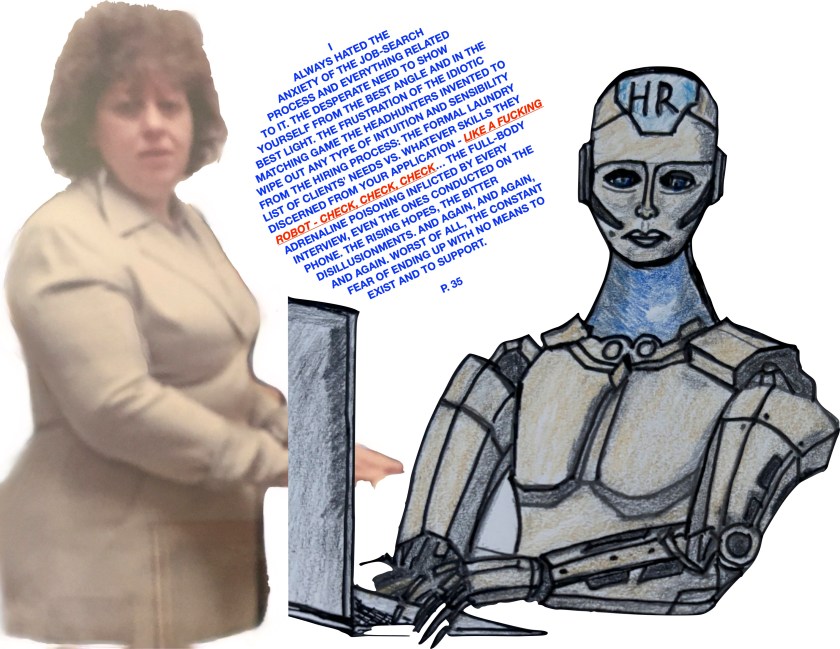
I Built This Prison: Teaser #3: I Just Hate Job Hunting


I always hated the anxiety of the job-search process and everything related to it. The desperate need to show yourself from the best angle and in the best light. The frustration of the idiotic matching game the headhunters invented to wipe out any type of intuition and sensibility from the hiring process: the formal laundry list of clients’ needs vs. whatever skills they discerned from your application – like a fucking robot – check, check, check… The full-body adrenaline poisoning inflicted by every interview, even the ones conducted on the phone. The rising hopes, the bitter disillusionments. And again, and again, and again. Worst of all, the constant fear of ending up with no means to exist and to support.

  I Built This Prison, p. 35

Job Search: Napoleon Bonaparte Is Hiring


This is a story my friend shared with me.  It just happened.

A headhunter, with whom she worked in the past has contacted her.  He has a client looking for someone with her qualifications.   She is always interested to hear about new opportunities, especially those with potential to expand her CFO expertise.

Surprisingly, the urgency in the headhunter’s voice was incredible.  He sounded like a 911 caller witnessing an explosion.  He rushed through the sentences, jumped from one point to another like a mad frog, even forgot to tell her what was the client’s business .  Somewhere in the middle of it,  my friend has realized that she was somewhat overqualified for the job.  Moreover,  the title and the compensation weren’t defined.  That should have alarmed her.  Yet in her vanity, and she knows it, she decided that all the hurriedness was fueled by the headhunter’s worries of her not being interested.

Actually, there were a few aspects of the job that sparked her interest.  My friend relayed this to the headhunter.   He was very excited and went about contacting the client on the next step. 

Oh, my God!  Within a couple of hours, he called her eleven times: “Setting up a phone interview; no, they are foregoing the phone interview and want to meet you in person straight away; you will meet four different people; no, just two; no, it will be two separate interviews back to back – first with the HR Manager and then with the Owner.  Please, pleeeeese, can we do it tomorrow?” 

And so, the next day my firiend went to the company’s offices and met with the HR Manager.  Talking to him, she was wondering if he would be able to make it through the meeting without falling into a panic attack.  Eventually,  he led her through the hallway to meet with the Owner/CEO.   His agitation escalated in alarming stages.  It was like playing a Liszt’s Etude, which calls for “fast” on the first page, then for “faster” on the second, “as fast as possible” on the third, and still “faster” on the next.

At the very moment she got to shake the hand of the tiny man behind the huge desk, it finally dawned on her.  It had nothing to do with my friend and her qualifications.  This miniature boss of an interesting, but relatively tiny company ($30M) exuded a sense of grandeur of Napoleonic proportions.  He had everyone scurrying like scared mice.  Even those who were not employed by him; including the headhunter, who works for one of the top 3 international recruitment houses.

The first thing he told her was, “I need a second in command who can keep the troops under control.  There were two before you, who were dismissed.”  Funny guy!

Job Search: CFO’s References Trap


I have no clue how those big-time CFOs, with seven-figure salaries, manage to get fired for screwing up and immediately land new jobs.  It's like, their skins are coated with teflon and nothing sticks.  And that's fine.  May be they deserve such recognition.   Most definitely, the companies who hire them deserve what they get.

Those CFOs and Controllers who toil in smaller companies, rarely get fired for poor performance.  If they are knowledgeable, diligent and hands-on, they don't screw up.   Yet, no matter how hard they work, they can loose their jobs.  The owner retires; or someone makes him an offer he cannot refuse; or, despite everyone's best efforts, the business goes under.  Very rarely one of us gets fed up with the abuse and quits on his own – I know a few  brave people.

Well, nobody waits for the unemployed small business CFO or Controller with a new position.  Nobody knows who he is.  There are nearly 6 million companies with less than 100 employees in this country.  Recruiters have never heard of them.  So, this erudite, experienced, smart and loyal professional is thrown into the grinding machine of job searching, where every CFO/Controller listing generates thousands of responses. 

It turns out, the trickiest part of the small business CFO's job search is the references list.  Of course, you've got your connections – bankers, auditors, attorneys.  There are former coworkers and subordinates who will be happy to speak about you.  You compiled a two-page long list of excellent professional references.  But… it fails. 

Why?  Because there are no "supervisors" on the list.  Well, technically, if you are a real CFO, no one supervises you.  The only person (sometimes, there are two)  between you and the higher powers of the Universe is the Owner/CEO.   And how many of them did you have in the past 15 years anyway? Two?  Three?

In some instances, they are still reachable and you have permission to use them as references.  However, most of the time…  Who are you going to use?  The one, who sold the company and went back to Thailand?  Or the guy who has  been hiding from creditors and changed all his contacts?

Now you have this prospective employer – another privately-held company.  You passed all interview levels, including the owner.  He seems to like what he is hearing from you very much.  At the end, he asks,"May I have your last boss's number?"  Didn't you just tell this guy that you were cheated out of your annual bonus at that job?

Here is my advice: 

  • ALWAYS expect that someone will want to speak with at least one of your old bosses. 
  • During the interview process, never reveal anything that may come back to haunt you. 
  • If your wonderful reference list is not enough, never show any resistance to providing the former bosses' contacts.  It's very suspicious and will end your chances right then and there. 
  • Give them whatever info you have. Who knows what's going to happen?

This is the best you can do. 

First Impression Is the Most Lasting Indeed


They say that the first impression is the most lasting one.  And it is true even for those people who try very  hard to be fair and give people a chance to show their true qualities. 

I myself is one of those people who make themselves look past the appearance of a job applicant.  Few years ago I have interviewed a woman who was grossly obese and needed a cane to assist her in moving her body.  I knew right away that aside from possible health issues, there could be multitude of other problems: we would need to order her a special X-large chair, my CEO may not like someone like that to be prominently installed in the Operations Department, visiting business relations may be destructed by the sight, etc. etc. 

Nevertheless, I gave her a full interview, which she passed with flying colors, and ended up hiring her.  It never even occurred to me not to offer her the salary attached to the position.  She got paid the same wages anyone in her place would.

Turns out, I am a rare exception.  Please, read this post from Vault's Career Blog Does your weight determine your salary?  The statistical data reported in the article are appalling.

Weight issue aside, my opinion is that when it comes to hiring process the entire "first impression" concept is very unprofessional.  Time after time, hiring execs, recruiters and variety of HR professionals yield to their contrived, closed-minded, self-centered views of other people instead of thinking of what's best for their companies.

Two weeks ago my good friend MJZ, also a career CFO, went for a job interview to a company that provides services to children with learning disabilities and autism under the contracts with various government health agencies.  Since such programs usually become first victims of states and counties budget cuts, the company desperately needs someone who can strategize their way into more diversified revenue models.   MJZ has a vast experience of building such strategies and facilitating companies' growth. 

She has previously had a phone interview and communications with the CEO's personal assistant.  So when in-person interview invitation was received, she assumed it would be with the CEO herself.  However, she was interviewed by a middle-rank HR Manager.  

When she told me that she did not even make it to the next round – the actual interview with the CEO (the HR Manager sent her an email), I've asked for the entire meeting description.  Now, knowing all details, I am confident that the HR Manager's rejection had nothing to do with MJZ's professional qualifications.  It had to do with the fact that she was dressed for an interview with the CEO and instead was assessed by a sweater-and-tights-clad middle-manager. 

The sad result is that the company had missed an opportunity to hire somebody who could have brought them to the next level of development.  Their loss, of course, but nevertheless a disappointing experience for my friend.